Showing posts with label supercar. Show all posts

Thursday, 22 August 2019

Audi Creates One-Off Electric Supercar For Will Smith

Could Audi’s new animated sports car preview the next real-world R8?

Gearheads will remember the 2004 science fiction flick I, Robot for the futuristic Audi RSQ concept created specifically for the film driven by Will Smith. It was a memorable piece of automotive product placement that previewed the original Audi R8 years before it went on sale.

Now, history could about to repeat itself because a unique Audi concept car will be driven by Will Smith’s character Lance Sterling in the upcoming animated film Spies in Disguise.

Dubbed the RSQ E-Tron, the supercar concept is presumably an evolution of the RSQ from I, Robot, but it could preview the real-world next-generation Audi R8. The design appears to be heavily inspired by the driver-focused Audi PB18 e-tron concept mixed with cues from the current R8. At any rate, the aggressive design looks far more appealing than the last RSQ, which featured spheres instead of conventional wheels in I, Robot. We wouldn’t complain if the next Audi R8 looks as good as this.

Naturally, the RSQ E-Tron is fully electric and has autonomous driving capabilities that will eventually be offered in future Audi e-tron cars. Since the concept car isn’t real, Audi has equipped the RSQ E-Tron with a plethora of crazy gadgets including cameras replacing traditional rearview mirrors, a holographic speedometer, and several dashboard-mounted displays.

While the RSQ E-Tron has self-driving technology, the driver can still regain control since the sports car includes a gearshift lever and steering wheel. The steering wheel folds away when the car is in autonomous mode.

You’ll have to wait until next September to see the Audi RSQ E-Tron on the big screen when Spies in Disguise releases in cinemas, but you can see the car in action right now in the embedded trailer below.

Saturday, 17 August 2019

Will Audi's 760-HP Electric Supercar Enter Production?

Audi designers are working hard to make it happen – but putting the concept into production presents several challenges.

Audi’s much-anticipated e-tron GT concept finally made its debut at the 2018 LA Auto Show last week with the Tesla Model S firmly in its sights. But it wasn’t the only electric Audi E-Tron concept revealed this year. Back in the summer at Pebble Beach, Audi revealed the PB18 E-Tron, a driver-focused electric supercar concept that could preview the Audi R8’s future replacement. Audi hasn’t confirmed plans to put it into production, but designers are working hard to make it happen according to Autocar.

Speaking at the LA Auto Show, Audi exterior design chief Andreas Mindt told the publication the design team are “absolutely pushing” the car for production and were the “engine” in the company driving for it to be built. However, giving it the green light won’t be an easy decision for Audi as it would need to overcome several challenges to put the electric supercar concept into production.

The car’s central driving position, for example, would require Audi to develop a new drive-by-wire steering system. This would be very expensive and difficult to justify for a low-volume car. The cockpit’s unconventional design would also be difficult to implement in the production model. In the concept, the driver’s seat and dashboard can also be positioned in two ways: either to the left of the interior like a typical road car, or in the center, as in a traditional race car.

Mindt also said engineers would need to develop adequate cooling systems for the powerful all-electric powertrain. The concept was powered by three electric motors, with one mounted within the front axle delivering 201 hp and another two positioned on either side of the rear axle producing 234 hp each. This results in a combined output of 671 hp, but a boost function increases this to 764 hp for short bursts of acceleration.

With this setup, Audi claimed the PB18 E-Tron concept could sprint from 0-62 mph in two seconds and hit a top speed of over 186 mph. The PB18 E-Tron concept also uses solid-state batteries with a capacity of 95 kWh, but the technology is not yet ready for production.

Wednesday, 7 August 2019

764-HP Audi PB18 e-tron Concept Is The Driver-Focused Electric Supercar Of Our Dreams

The cockpit can be switched from a two-person layout to a single-seater for track driving.

We’re so used to seeing futuristic-looking concept cars designed to showcase advanced autonomous driving technology that Audi’s latest concept car is wholly refreshing. Presented at Pebble Beach, the Audi PB18 e-tron Concept is devoid of self-driving technologies. Instead, Audi has focused on the driving experience to show what the driver-focused electric supercar of our dreams could look like in the future.

Three electric motors power the car, with a 201-hp unit at the front and two other motors powering the rear wheels providing an additional 604 hp. Drive it conservatively, and the concept delivers a combined power output of 671 hp and 612 lb-ft of torque, but peak power of 764 hp is possible in short bursts, allowing the concept to hit 0-62 mph in a little over two seconds.

As well as being powerful, the concept has also been designed to be extremely efficient. While being driven, the Audi PB18 e-tron recovers large amounts of energy as the electric motors are solely responsible for slowing the car down during moderate braking, with the hydraulic brakes taking over for heavy braking. Having separate electric motors on the rear axles has also allowed Audi to implement a Torque Control Manager to enhance the car’s sporty handling. Working with the Electronic Stabilization Control, this system actively distributes the power to the wheels of the front and rear axles when needed for maximum stability and driving pleasure.

In terms of design, the PB18 e-tron's striking shape is inspired by Audi’s successful R18 e-tron quattro Le Mans race car and features a similar suspension setup combining push-rods on the front axle with pull-rods at the rear with magnetic ride shock absorbers. The wheels measure 22 inches in diameter and are fitted with 275/35 tires in the front and 315/30 in the back. Large carbon brake discs with a 19-inch diameter provide significant stopping power in conjunction with the electric brake.

The interior is also very futuristic as the cockpit can be switched from a two-person layout to a single-seater configuration for track driving. With the latter setup, the driver is cocooned in the center of the cockpit. The windshield also incorporates an augmented reality system that displays information such as the ideal racing line. Sadly, Audi isn’t planning to put the PB18 e-tron into production, but we’re hoping it will one day inspire a future halo car to showcase the technology of Audi's electric e-tron range.

Monday, 24 June 2019

2019 Audi R8 First Drive Review: More Power, Sharper Suit For Audi's Supercar

Enjoy the Lamborghini V10 while you still can.

There’s no other sports or supercar quite like the Audi R8 – it’s a paradoxical mix of high-tech infotainment and old school V10 engine; of Lamborghini genes and sensible-shoes usability; of searing performance at – in this rarefied segment – a relatively affordable price point. Now Audi has re-booted its mid-engined halo for 2019, admitting all variants to the 200-mph club in the process.

A relatively light tweak it might be, but with Audi rumored to axe the R8 after this second generation or re-imagine it as an all-electric or plug-in hybrid, this is our last chance to enjoy ten cylinders screaming to an incendiary 8,250 rpm.

As before, Coupe or Spyder models are available, both with all-wheel drive, an S-tronic dual-clutch gearbox and that scintillating V10 in two states of tune. When we ask if the cheaper rear-wheel-drive RWS might return, Audi Sport engineers look around nervously and don’t say no. Fingers crossed for that. For now, we’re driving the top-spec coupe: the V10 Performance. With the car still awaiting homologation, we’ve come to the Ascari racetrack in Spain for our drive.

Exterior Design: First Impressions

The changes to the R8 are relatively subtle, but even parked a distance away in the Ascari pit lane it looks different, especially the front: lower and wider, kind of like it’s wearing a mouthguard, but the new jaw is effective in creating a more purposeful look. Look closer and there’s a flatter front grille, three little slits at the leading edge of the hood that recall the Ur Quattro, and a new, wider front splitter.

Changes at the rear are less obvious, with the design team having to draw our attention to the more upswept rear diffuser.

Interior Design And Features

There are two new colors (Kemora Grey, Ascari Blue), new 19-inch alloys (20s for the V10 Performance) and some gloss-black detailing on the standard model, replaced by matte titanium on the Performance.

The interior is unchanged, but plus points include a great driving position, solid build with flashes of flair, and Audi’s virtual cockpit for a slick, modern feel. Important to remember that the Spyder, like before, has a tighter cockpit due to the roof mechanism – if you’re taller than six-feet, you’ll struggle for legroom.

Engine And Performance: Turning The V10 Up To 11

Both versions of the naturally aspirated 5.2-liter V10 get extra power. The standard model now produces 533 hp at 8,250 rpm, an increase of 30 hp, and 406 lb-ft at a high 6,500 rpm, up 7 lb-ft. All of it is purely down to software calibration changes, and helps even the heavier Spyder to score 200 mph.

The Performance we’re driving now produces 612 hp and 428 lb-ft, which is 10 hp / 15 lb-ft stronger than before, and now a little beyond the Lamborghini Huracan too, if not the range-topping Huracan Performante.

These gains come from a valvetrain revised with titanium components as well as fresh ECU mapping. It means the V10 Performance coupe can accelerate from zero to 62 mph in 3.1 seconds and reach 206 mph – one-tenth and 1 mph up on previously.

Revised Chassis

Audi engineers have played around with the chassis, though the basic spring rates and damper specs remain unchanged – there are apparently greater steps between the driving modes, but as we’re driving on track in the Dynamic ‘dry’ setting, we’ll have to wait for another test drive to spot those nuances.

All our test cars are fitted with a new optional anti-roll bar made from carbon fiber and aluminum. It’s laid out next to the standard item in the pit garages and the difference is striking – you could work out with the old one, where the new, 4.5-lb lighter roll bar wouldn’t so much as raise your heartbeat.

The choice of standard or Dynamic steering continues, both updated with calibration changes and available for us to sample. It’s also worth noting that all test cars are fitted with Michelin Cup 2 tires, optional track-focused rubber that you’ll find on a 911 GT3 and Ferrari 488 Pista. No-one at Audi seems to know which markets will be offered these tires.

At The Wheel

Ascari is a fast track, its fear factor multiplied by walls for run-off, blind, heartbeat entries to some corners, and other turns that seem to roll on forever in third and fourth gear, goading you to accelerate earlier than you really should.

Flatten the accelerator in first and the all-wheel drive claws at the pit exit’s dry surface, the V10 rips round past 8,000 rpm while the digital rev counter strobes red in the corner of your eye, and the first to second gear shift thwacks in, full of mechanical menace.

The bare figures tell you performance has moved on with the likes of the McLaren 720S, but this remains visceral acceleration that requires some acclimatisation, even if the small power hike is not particularly obvious.

Standard carbon-ceramic brakes fitted to the Performance (optional for lesser V10s) wipe off speed into the first tight, downhill left-hander – no ABS intervention, big stopping power, maybe a little bagginess at the top of the pedal – and as you aim for the apex, you get a first glimpse of the R8’s sweet balance off-throttle. It turns keenly and with modest, well-supported roll, partly a benefit of the mid-engined layout. But the downhill braking zone exaggerates the weight of the V10 in the back, which starts to swing round – it’s a balance that makes the R8 feel even more nimble and reactive, but it’s definitely a pendulum effect that must be anticipated and nursed.

The stability control’s unintrusive Sport setting and all-wheel drive helps, and under full power as the corner opens and quickens, the nose hooks up and pulls the car out. It switches the balance to a neutral, slightly understeery feeling, and you have to moderate the combination of front-end push and fast-escalating speed. The previous rear-wheel-drive R8 had a more fluid, less manic feeling, but it’s certainly sure-footed. Remember the standard tires will feel less precise on track.

At higher speeds and gears you get more time to appreciate the V10 –the crispness of its response, the linearity of the delivery, but more than anything it’s the bandwidth in the final 1,000 rpm of the rev range and a scream like a distressed chicken that makes the R8 so enjoyable.

The trade is that it feels less enthusiastic at lower revs than a turbo rival and you quickly bog down if you’re a gear too high, but super-quick gear shifts keep you in the power band, even if they do lose the mechanical edge of brutal low-speed acceleration at heartbeat speed.

After a few laps, it’s time to switch into a car with the Dynamic steering, complete with chassis engineer in the passenger seat. He’s candid that he prefers the standard system, but the Dynamic set-up works well, particularly through quick direction changes. There is, however, a less natural sense of support through the long, fast corners, where the slower, heavier feel of the regular steering is preferable. There’s no huge mistake to be made here, but we’d stick with the standard set-up.

Verdict, Prices And Trims

Despite a very mild makeover, the Audi R8 remains a compelling choice, one that’s unfairly overlooked. A McLaren 570S is a lighter, more nimble and more tactile feeling car, but the R8 is cheaper than its British rival and by far the more useable everyday proposition –better refinement, better technology, easier to actually climb into, and offering the security of all-wheel drive and a mainstream dealer network too. And it’s still a relatively safe and invigorating way to explore a racetrack.

More than anything though, the R8 gets our hearts racing because it combines all this level-headedness with a hand built naturally-aspirated Lamborghini V10 that sears and yelps and makes the 570S seem gruff and characterless in comparison. Don’t miss the chance to appreciate it while you still can.

Prices and on-sale dates are TBC, but expect the $165,000 entry model to increase to around $170,000 and the top-spec $194,000 V10 coupe to hit $200,000.

Friday, 14 June 2019

Will Audi's 760-HP Electric Supercar Enter Production?

Audi designers are working hard to make it happen – but putting the concept into production presents several challenges.

Audi’s much-anticipated e-tron GT concept finally made its debut at the 2018 LA Auto Show last week with the Tesla Model S firmly in its sights. But it wasn’t the only electric Audi E-Tron concept revealed this year. Back in the summer at Pebble Beach, Audi revealed the PB18 E-Tron, a driver-focused electric supercar concept that could preview the Audi R8’s future replacement. Audi hasn’t confirmed plans to put it into production, but designers are working hard to make it happen according to Autocar.

Speaking at the LA Auto Show, Audi exterior design chief Andreas Mindt told the publication the design team are “absolutely pushing” the car for production and were the “engine” in the company driving for it to be built. However, giving it the green light won’t be an easy decision for Audi as it would need to overcome several challenges to put the electric supercar concept into production.

The car’s central driving position, for example, would require Audi to develop a new drive-by-wire steering system. This would be very expensive and difficult to justify for a low-volume car. The cockpit’s unconventional design would also be difficult to implement in the production model. In the concept, the driver’s seat and dashboard can also be positioned in two ways: either to the left of the interior like a typical road car, or in the center, as in a traditional race car.

Mindt also said engineers would need to develop adequate cooling systems for the powerful all-electric powertrain. The concept was powered by three electric motors, with one mounted within the front axle delivering 201 hp and another two positioned on either side of the rear axle producing 234 hp each. This results in a combined output of 671 hp, but a boost function increases this to 764 hp for short bursts of acceleration.

With this setup, Audi claimed the PB18 E-Tron concept could sprint from 0-62 mph in two seconds and hit a top speed of over 186 mph. The PB18 E-Tron concept also uses solid-state batteries with a capacity of 95 kWh, but the technology is not yet ready for production.

Wednesday, 8 May 2019

Audi Will Reveal The PB 18 e-tron Electric-Drive Supercar Concept Next Month

Could this be a preview of a future halo supercar?

Audi has just announced next month it will unveil an electric-drive supercar concept at the Pebble Beach Concourse d’Elegance Week, appropriately called PB 18 e-tron. ‘PB’, of course, stands for Pebble Beach and the year is 2018. The name choice also takes into account the Le Mans-series winner Audi R18 e-tron. The automaker offers very few details about the concept itself, only that it was conceived and designed by the new Audi Design Loft in Malibu, California. That Le Mans-series winner featured many new technologies that Audi claims “inspired the solutions for various details.” What details?

Also unknown for now. However, we get the clear impression the PB 18 e-tron is track-focused. The same weekend it’s making its Pebble Beach debut, it will also be heading to Southern California’s Laguna Seca racetrack as part of the Rolex Monterey Motorsports Reunion reception. Will it also do some sort of track demo for the audience? It’s certainly possible. But for now we’ll have to make do with the single image of the PB 18 e-tron’s front end, though it’s still pretty well disguised. It certainly does look aggressive even from this angle thanks to those headlights, low roofline, and bulging front fenders.

Could the PB 18 e-tron be an early preview of an eventual R8 successor? Absolutely. But what thing is certain: Audi is continuing to move at a brisk pace towards electrification. Wouldn’t having a new halo supercar showcasing that technology be ideal? We think so. Full details to come on August 23.

Thursday, 2 May 2019

Aston Martin V12 Vantage V600 Is A Limited Run Purist Supercar

Naturally aspirated V12? Check. Six-speed manual? Oh yeah.

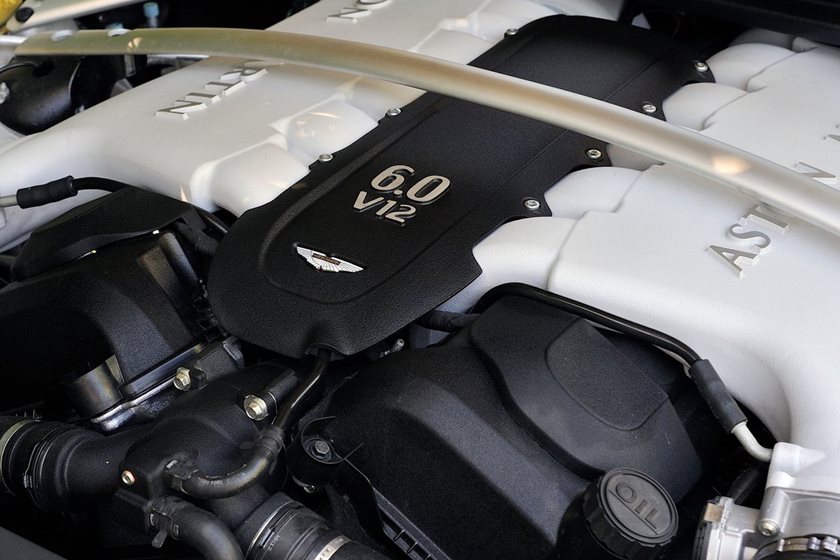
Although an all-new Aston Martin V8 Vantage now exists, there’s no V12 Vantage replacement, at least not yet. Partly because of this lineup void, Aston Martin’s bespoke division, Q by Aston Martin, fulfilled a customer commission to build one final V12 Vantage. That customer ultimately agreed to allow 14 examples to be built. Based on previous generation-based V12 Vantage, the V12 Vantage produces a total of 600 hp, courtesy of its naturally aspirated 6.0-liter V12 engine, mated solely to a six-speed manual.

It’s about as analog as one can get these days, a combination that won’t be around much longer. Called the “Triple V”, a total of seven coupes and seven roadsters will be built. Aston Martin claims this is the “ultimate analog Vantage.” The engine has been slightly upgraded, but the most noticeable alterations are in the styling department. For starters, there’s a full carbon fiber exterior. It’s also worth noting the V12 V600 is influenced by the original V8 Vantage V600 from 1998. Therefore, the new car features a re-imagined side-strake and a bulging hood to create an overall more aggressive look. The darkened front grille offers maximum air and cooling, which is obviously vital for a V12.

Out back there’s a new carbon fiber diffuser and a quad exhaust system. The final exterior upgrades include a set of bespoke forged and machined aluminum wheels. Step inside and you’ll find an abundance of even more carbon fiber along with dark anodized aluminum bits. Even the center console is made solely of carbon fiber. The seats are lightweight and even have a new perforation pattern. Lastly, there’s a hand-crafted saddle leather center armrest. Official pricing has not been announced, but clearly the V12 Vantage V600 is for seriously and wealthy collectors only. Aston Martin says deliveries will begin for the select few buyers later this year.


View the original article here

Monday, 18 February 2019

Aston Martin Names New Supercar (Yes, It Starts With A 'V')

An awesome name for what will be an awesome car.

For months now, rumors have been circulating about a mid-engined Aston Martin model, which would rival the Ferrari 488 and Mclaren 720S. Very little is currently known about the car, other than it will likely be the first in a new line of mid-engined models from Aston Martin, slotting under the upcoming Valkyrie hypercar.

Originally, this new car was rumored to revive the Vanquish name. Since the hardcore version of the DB11 has now reverted back to the DBS name, the Vanquish name is freed up for use elsewhere. As it turns out, Auto Guide now claims Aston will use a different name on its upcoming supercar.

A new trademark application with the World Intellectual Property Organization for the name "Aston Martin Valhalla" has been filed to be used on “passenger cars and racing cars and parts and fittings therefor."

Speaking to Australian outlet, Drive, Aston Martin's chief creative officer Marek Reichman said the Valhalla name was being saved for an upcoming supercar.

We previously knew the Valhalla as Project 003, which was accompanied by a single vague sketch. It wasn't clear whether Project 003 referred to the rumored 488 rival or a potential rival for the upcoming McLaren Speedtail. Known internally as the "Son of Valkyrie," the Valhalla will be closer to the latter with a turbocharged V6 hybrid set up and performance comparable to the LaFerrari.

Co-developed with RedBull, the name Valhalla directly connects to the Valkyrie name used on Aston Martin's other upcoming mid-engine hypercar.

In Norse mythology, a Valkyrie was a female figure who would decide which warriors would die and which would live. If the Valkyrie chose a warrior to die, they would be lead to the hall of the slain in Valhalla (basically the equivalent of heaven).

We expect the Valhalla to arrive sometime in 2021, with only 500 units slated for production.


View the original article here

Wednesday, 13 February 2019

Aston Martin’s Mid-Engined Supercar Will Revive The Vanquish Name

Aston Martin promises “it will be the most beautiful car on the road.”

Aston Martin recently revived the iconic DBS moniker with the unveiling of the hardcore DBS Superleggera last month to replace the Vanquish. This left us wondering if the flagship Vanquish name, which usually represents the fastest and most powerful car in Aston Martin’s production car range, will ever return. Well, it turns out the Vanquish badge isn’t being retired because Aston Martin has been reserving the nameplate for its upcoming mid-engined supercar that will fight the Ferrari 488 in 2021.

“Without saying yes, that sounds like a plausible solution for a beautiful name like Vanquish,” the company’s chief creative officer Marek Reichmann told Motoring when asked if the new mid-engined supercar will be called the Vanquish. And just to clear any doubts, Reichmann confirmed that one of Aston Martin’s seven cars arriving in the next seven years will bear the Vanquish badge.

“Obviously, Vanquish is an incredible name for us. Ever since the first Vanquish, it has stood as the most powerful brute in the family but we felt, more importantly, this was a true DBS more than a Vanquish because of the base product and how we’ve derived it to get to DBS,” Reichmann said.

“It’s a more appropriate name for this car. Vanquish is a very special name and we’ve got some pretty special cars coming.” Now that the DB11, Vantage and DBS Superleggera have broken cover, there are four cars left for Aston Martin to unveil as part of its Second Century plan: a mid-engine supercar, an SUV, and two Lagonda electric cars. No prizes for guessing which car will be named the Vanquish.

Now that the name is confirmed, the mid-engined Aston Martin Vanquish’s design is nearing completion. Reichmann revealed the design team has already produced 12 scale models and three full-size models.

Along with a name, the mid-engined Aston Martin Vanquish’s design is nearing completion. Reichmann revealed Aston’s design team had already produced 12 scale model designs and three full-size models during the development process. “Car number 5 is our mid-engined car, and our freedom really comes from having a completely different layout,” he said. “The credibility to get to that series production car comes all through Valkyrie, both 001 and 002. It will be the most beautiful mid-engined car on the road… with all the learnings from Valkyrie.”

Unsurprisingly, Reichmann didn’t provide any technical details, but he did tease the mid-engine supercar will rival the Ferrari 488, Lamborghini Huracán, and McLaren 720S and borrow elements from the Valkyrie hypercar. Like the Valkyrie, it will also receive input from the Red Bull Formula One racing team, so expect it to be extremely light and feature an array of active aerodynamics. Power is expected to combine Aston Martin’s AMG-sourced 4.0-liter twin-turbo V8 and an electric motor.

Sunday, 9 December 2018

2019 Audi R8 First Drive Review: More Power, Sharper Suit For Audi's Supercar

Enjoy the Lamborghini V10 while you still can.

There’s no other sports or supercar quite like the Audi R8 – it’s a paradoxical mix of high-tech infotainment and old school V10 engine; of Lamborghini genes and sensible-shoes usability; of searing performance at – in this rarefied segment – a relatively affordable price point. Now Audi has re-booted its mid-engined halo for 2019, admitting all variants to the 200-mph club in the process.

A relatively light tweak it might be, but with Audi rumored to axe the R8 after this second generation or re-imagine it as an all-electric or plug-in hybrid, this is our last chance to enjoy ten cylinders screaming to an incendiary 8,250 rpm.

As before, Coupe or Spyder models are available, both with all-wheel drive, an S-tronic dual-clutch gearbox and that scintillating V10 in two states of tune. When we ask if the cheaper rear-wheel-drive RWS might return, Audi Sport engineers look around nervously and don’t say no. Fingers crossed for that. For now, we’re driving the top-spec coupe: the V10 Performance. With the car still awaiting homologation, we’ve come to the Ascari racetrack in Spain for our drive.

Exterior Design: First Impressions

The changes to the R8 are relatively subtle, but even parked a distance away in the Ascari pit lane it looks different, especially the front: lower and wider, kind of like it’s wearing a mouthguard, but the new jaw is effective in creating a more purposeful look. Look closer and there’s a flatter front grille, three little slits at the leading edge of the hood that recall the Ur Quattro, and a new, wider front splitter.

Changes at the rear are less obvious, with the design team having to draw our attention to the more upswept rear diffuser.

Interior Design And Features

There are two new colors (Kemora Grey, Ascari Blue), new 19-inch alloys (20s for the V10 Performance) and some gloss-black detailing on the standard model, replaced by matte titanium on the Performance.

The interior is unchanged, but plus points include a great driving position, solid build with flashes of flair, and Audi’s virtual cockpit for a slick, modern feel. Important to remember that the Spyder, like before, has a tighter cockpit due to the roof mechanism – if you’re taller than six-feet, you’ll struggle for legroom.

Engine And Performance: Turning The V10 Up To 11

Both versions of the naturally aspirated 5.2-liter V10 get extra power. The standard model now produces 533 hp at 8,250 rpm, an increase of 30 hp, and 406 lb-ft at a high 6,500 rpm, up 7 lb-ft. All of it is purely down to software calibration changes, and helps even the heavier Spyder to score 200 mph.

The Performance we’re driving now produces 612 hp and 428 lb-ft, which is 10 hp / 15 lb-ft stronger than before, and now a little beyond the Lamborghini Huracan too, if not the range-topping Huracan Performante.

These gains come from a valvetrain revised with titanium components as well as fresh ECU mapping. It means the V10 Performance coupe can accelerate from zero to 62 mph in 3.1 seconds and reach 206 mph – one-tenth and 1 mph up on previously.

Revised Chassis

Audi engineers have played around with the chassis, though the basic spring rates and damper specs remain unchanged – there are apparently greater steps between the driving modes, but as we’re driving on track in the Dynamic ‘dry’ setting, we’ll have to wait for another test drive to spot those nuances.

All our test cars are fitted with a new optional anti-roll bar made from carbon fiber and aluminum. It’s laid out next to the standard item in the pit garages and the difference is striking – you could work out with the old one, where the new, 4.5-lb lighter roll bar wouldn’t so much as raise your heartbeat.

The choice of standard or Dynamic steering continues, both updated with calibration changes and available for us to sample. It’s also worth noting that all test cars are fitted with Michelin Cup 2 tires, optional track-focused rubber that you’ll find on a 911 GT3 and Ferrari 488 Pista. No-one at Audi seems to know which markets will be offered these tires.

At The Wheel

Ascari is a fast track, its fear factor multiplied by walls for run-off, blind, heartbeat entries to some corners, and other turns that seem to roll on forever in third and fourth gear, goading you to accelerate earlier than you really should.

Flatten the accelerator in first and the all-wheel drive claws at the pit exit’s dry surface, the V10 rips round past 8,000 rpm while the digital rev counter strobes red in the corner of your eye, and the first to second gear shift thwacks in, full of mechanical menace.

The bare figures tell you performance has moved on with the likes of the McLaren 720S, but this remains visceral acceleration that requires some acclimatisation, even if the small power hike is not particularly obvious.

Standard carbon-ceramic brakes fitted to the Performance (optional for lesser V10s) wipe off speed into the first tight, downhill left-hander – no ABS intervention, big stopping power, maybe a little bagginess at the top of the pedal – and as you aim for the apex, you get a first glimpse of the R8’s sweet balance off-throttle. It turns keenly and with modest, well-supported roll, partly a benefit of the mid-engined layout. But the downhill braking zone exaggerates the weight of the V10 in the back, which starts to swing round – it’s a balance that makes the R8 feel even more nimble and reactive, but it’s definitely a pendulum effect that must be anticipated and nursed.

The stability control’s unintrusive Sport setting and all-wheel drive helps, and under full power as the corner opens and quickens, the nose hooks up and pulls the car out. It switches the balance to a neutral, slightly understeery feeling, and you have to moderate the combination of front-end push and fast-escalating speed. The previous rear-wheel-drive R8 had a more fluid, less manic feeling, but it’s certainly sure-footed. Remember the standard tires will feel less precise on track.

At higher speeds and gears you get more time to appreciate the V10 –the crispness of its response, the linearity of the delivery, but more than anything it’s the bandwidth in the final 1,000 rpm of the rev range and a scream like a distressed chicken that makes the R8 so enjoyable.

The trade is that it feels less enthusiastic at lower revs than a turbo rival and you quickly bog down if you’re a gear too high, but super-quick gear shifts keep you in the power band, even if they do lose the mechanical edge of brutal low-speed acceleration at heartbeat speed.

After a few laps, it’s time to switch into a car with the Dynamic steering, complete with chassis engineer in the passenger seat. He’s candid that he prefers the standard system, but the Dynamic set-up works well, particularly through quick direction changes. There is, however, a less natural sense of support through the long, fast corners, where the slower, heavier feel of the regular steering is preferable. There’s no huge mistake to be made here, but we’d stick with the standard set-up.

Verdict, Prices And Trims

Despite a very mild makeover, the Audi R8 remains a compelling choice, one that’s unfairly overlooked. A McLaren 570S is a lighter, more nimble and more tactile feeling car, but the R8 is cheaper than its British rival and by far the more useable everyday proposition –better refinement, better technology, easier to actually climb into, and offering the security of all-wheel drive and a mainstream dealer network too. And it’s still a relatively safe and invigorating way to explore a racetrack.

More than anything though, the R8 gets our hearts racing because it combines all this level-headedness with a hand built naturally-aspirated Lamborghini V10 that sears and yelps and makes the 570S seem gruff and characterless in comparison. Don’t miss the chance to appreciate it while you still can.

Prices and on-sale dates are TBC, but expect the $165,000 entry model to increase to around $170,000 and the top-spec $194,000 V10 coupe to hit $200,000.

Saturday, 8 December 2018

Budget Supercar Comparo: Audi R8 V10 Spyder Vs Porsche Turbo Cabrio

Don't worry about breaking the bank on these two Germans.

Apparently Motor Trend’s YouTube commenters are angry at Jonny Lieberman and friends for not testing enough cars that they can afford. So Lieberman and Randy Pobst decided to take things a little easier by setting a price ceiling of, oh, say $200,000. Pretty reasonable right? We’ll leave that for the commenters to decide. Either way, the type of German hardware these guys are messing with is known for rarely leaving anything to be desired.

First up is the Audi R8 V10 Spyder. Its contender is none other than the Porsche 911 Turbo Cabriolet. In the spirit of thrift, Motor Trend keeps the Porsche as a “regular” Turbo Cabriolet model and not the Turbo S Cabriolet, which would nudge the price over the $200,000 line. Keeping things basic is much more simple to do with Audi.

Though Audi makes the R8 coupe with the V10 Plus package, the Spyder only gets the non-upgraded V10, leaving it so that both cars have the same 540 horsepower output being sent to all four wheels through seven-speed dual clutch automatics. Who ever accused the Volkswagen Group of redundancy? Actually not many, and the variations in each car—which makes it so that those specs perform much differently than one another on the road and track—are enough to give reason for Volkswagen to keep making each. Still, this is a comparison for those broke enough to only afford one, so which will it be?

Friday, 7 December 2018

The Audi RS6 Consistently Proves It Can Humiliate Any Supercar

The RS6 recently beat a GT-R around the track, but now it’s going after its own family members.

In the past few weeks, Internet witnesses have seen automotive journalists begin to discover just how impressive the RS6 Performance really is. Based on the A6 Avant, the RS6 fitted with the optional performance package is no hot hatch since its dimensions and the eye-opening weight figure makes sure of that. Still, the RS6 Performance packs a gut-punching 597 horsepower and 516 lb-ft of torque going to all four wheels via an eight-speed gearbox.

That’s a slight bit more than its supercar cousin, the Audi R8. The Spider we see here may be a bit heavier than its wagon sibling thanks to chassis reinforcements, but it shouldn’t add too much of a burden to the 5.2-liter V10 engine that makes 533 horsepower and 398 lb-ft of torque.

The funny thing is, burdened or not, the RS6 Performance is a hell of a machine that can even challenge a diehard track machine like the Nissan GT-R. We shouldn’t expect the RS6 to pull off the same supercar humiliating trick here given the R8’s mid-engine handling superiority, but in a straight line, things are different. Thanks to a consistent and intense performance on the part of the RS6’s 4.0-liter twin-turbo V8, things skew in the wagon’s favor. Looks like there just might be a replacement for displacement.

Wednesday, 3 October 2018

However In many Circumstances

Do not disturb the connection between AutoHex II and the automotive while Encoding. The instruments and companies which might be included which has a web hosting account permit businesses to cut again on prices while nonetheless getting the data and organizational instruments they must keep aggressive. You will come across each portable types to accommodate your purse, and a few bigger sized merchandise, that have to be positioned on a desk for occasion. Be ample with all the issues, so it will likely be easy for them to visualize cashing them in after a variety of orders. The letters “diag” will seem the place the odometer numbers are often displayed. All the photographs can be found both for parallel viewing (left eye views left image, right eye views right image), as well as for cross-eyed viewing (left eye views proper image, right eye views left picture). Identical things on the preliminary start, fires proper up, like a champ.


Lovely workplace with red rosesThere is always an occasion that can be celebrated with an exquisite and fragrant bunch of colorful blossoms. If you have had no airbag deployment after a automobile accident, there will not be something wrong together with your automotive. Sensible experience could also be the important thing to discovering success as a webmaster. Do you want a Webmaster on your companys webpage? On the webmaster console, you can access your crawling stats. Can I copyright the name of my band? Most of these coins may be utilized problem coins on the market regard to boundless features that can make anybody desire these individuals. We are going to help you progress search engine visitors into potential shoppers or webpage followers by implementing On-Site and Off-Site methods. And at last select the one which is able to completely help you in a totally fledged manner.Most of the companies on the earth are automatically enrolling their staffs or workers to a finest out there pension scheme.


Including some colorful tissue paper or shred and perhaps a floral or seasonal enhancement will fill in the areas between the objects and add curiosity to the design. There's an issue with the sensor that provides the data for this gauge. There are a few points right here, though. I've had this code show up on my car the final couple of years. Unfortunately, most older scan instruments will not work on the newer OBD II methods, and should be replaced with ones which have the proper hardware and software to learn OBD II codes and other diagnostic info. Merely clear codes or repair the underlying challenge because of Vance & Hines’ unique, in-depth how-to movies out there by way of the app. Summary: THIS TECHNICAL SERVICE BULLETIN NOTIFIES THE READER THAT IF THE TPMS MESSAGE Seems BRIEFLY AFTER THE ENGINE IS Began And then DISAPPEARS, IT Doesn't Point out A difficulty WITH THE TPMS SYSTEM. 999999km. then install cluster and put the automotive on contact for 1minute. then program cluster to any worth. Three to its default worth. The control module monitors the gas tank pressure (FTP) sensor voltage to confirm that the system is in a position to succeed in a predetermined degree of vacuum inside a set period of time.


Non-Steady Displays embrace O (Oxygen Sensor Monitor), OH (Oxygen Sensor Heater Monitor), C (Catalyst Monitor), HC (Heated Catalyst Monitor), E (EGR System Monitor), EV (EVAP System Monitor), 2A (Secondary Air System Monitor), and AC (Air Conditioning Monitor). Also found that hazard warning system does not work. For example, one firm was ordered to pay 40,000 EUR in compensation to a former worker once they had been discovered guilty of monitoring him without his data. NOW for Extremeterrain. I love this firm and their service. The basic rule of thumb when coping with multiple trouble codes saved in the power Control Module's (PCM) reminiscence is to clear the codes and see which return first. The engine light is on and that i pulled the codes P0417 P0171 P0174 P1443 Cant seem to find much data in what I want to test or substitute. With VIDA, you'll be able to browse all of the ECUs in the car (including CPM, the module answerable for the parking heater!) and ship diagnostic commands to test their performance.


Low resistance wires may cause interference. To begin with, you'll be able to go on to succeed in out to your friend’s place at 12 a.m. Step one in making repairs to your motorcycle is actually understanding what needs to be fixed in the primary place. However when it comes time to make a bike repair, skilled mechanics have the instruments and know-how wanted to disassemble and reassemble your automobile, make clear fixes, and get you again on the street. Firms carry the required insurance coverage so you have got your back protected. … it solely seems on the front page. What Does OBD-II Fault Code P0442 Mean? Instead I get a spark and a heating up screw driver. So what did you do to repair it, something? A ton of men and women come to a call towards individually consider rid of trojans and furthermore earthworms versus their options, nonetheless doing away with adware is an arduous and as effectively period-feeding on process.