Showing posts with label drive. Show all posts

Monday, 9 September 2019

Audi On Demand Lets You Drive An Audi For An Hour, Or A Month

This could change how we think of car ownership.

Ride-sharing services like Uber and Lyft have changed the way people think about car ownership. Why pay an exorbitant amount to own and insure your own car when you can just borrow one whenever you need it? Many automakers have taken notice of this shift in consumer thinking and have invested in their own ride-sharing services.

Audi previously tested a rental service in San Fransisco called 'Audi On Demand,' where users could rent any vehicle ranging from an A4 to an R8. The service never expanded across the entire US, but now Audi On Demand is back in the spotlight and will be tested in the UK.

Audi is hoping that it's new On Demand service will help make the rental process easier with a single all-in fee, which includes unlimited mileage, fully comprehensive insurance, roadside assistance, delivery, and collection. Prices range from £70 to £190 (around $90 to $242) depending on the model, and users can choose from a variety of cars including an A1, A3, A4, A5, Q3, and Q5. Some locations will also have convertible models such as the A3, A5, and S5. Unfortunately, Audi didn't mention any RS cars or the R8 - sorry enthusiasts.

Rentals range from just one hour to a 28-day period, meaning the service is highly flexible to suit your needs. If, for instance, you only need a Q5 SUV to pick up a piece of furniture, you can rent it for just an hour or two. As of now, the service is a bit limited - it runs out of Audi's Oldham facility near Manchester and can only deliver within a 30-minute driving radius, though there are plans to expand the service to more cities such as Edinburgh, Glasgow, Newcastle, Birmingham, and London in the coming months. The UK will now be one of several countries to offer Audi On Demand including the United States, China, Hong Kong, Singapore, Japan, and Germany, but its availability is still far from widespread.

Tuesday, 27 August 2019

Audi On Demand Lets You Drive An Audi For An Hour, Or A Month

This could change how we think of car ownership.

Ride-sharing services like Uber and Lyft have changed the way people think about car ownership. Why pay an exorbitant amount to own and insure your own car when you can just borrow one whenever you need it? Many automakers have taken notice of this shift in consumer thinking and have invested in their own ride-sharing services.

Audi previously tested a rental service in San Fransisco called 'Audi On Demand,' where users could rent any vehicle ranging from an A4 to an R8. The service never expanded across the entire US, but now Audi On Demand is back in the spotlight and will be tested in the UK.

Audi is hoping that it's new On Demand service will help make the rental process easier with a single all-in fee, which includes unlimited mileage, fully comprehensive insurance, roadside assistance, delivery, and collection. Prices range from £70 to £190 (around $90 to $242) depending on the model, and users can choose from a variety of cars including an A1, A3, A4, A5, Q3, and Q5. Some locations will also have convertible models such as the A3, A5, and S5. Unfortunately, Audi didn't mention any RS cars or the R8 - sorry enthusiasts.

Rentals range from just one hour to a 28-day period, meaning the service is highly flexible to suit your needs. If, for instance, you only need a Q5 SUV to pick up a piece of furniture, you can rent it for just an hour or two. As of now, the service is a bit limited - it runs out of Audi's Oldham facility near Manchester and can only deliver within a 30-minute driving radius, though there are plans to expand the service to more cities such as Edinburgh, Glasgow, Newcastle, Birmingham, and London in the coming months. The UK will now be one of several countries to offer Audi On Demand including the United States, China, Hong Kong, Singapore, Japan, and Germany, but its availability is still far from widespread.

Friday, 9 August 2019

2019 Audi R8 RWS Test Drive Review: The Hardcore R8 We’ve Been Waiting For?

Huracan chaser on the cheap? The sensibly-dressed 911 GT3 rival we've been waiting for? These and other questions the R8 RWS must answer.

Is Audi scared of rear-wheel drive? The panicked interventions from the R8 RWS’s stability control to any mid-corner throttle suggest it might well be, given ‘oversteer’ hasn’t really been in the brand lexicon since, well, ever. But I am in a mid-engined Audi supercar directing its 532hp through the rear wheels and a mechanical limited-slip differential. And the ESC is having a bit of a panic.

Perhaps not such a surprise given even Audi’s performance products tend to tread a cautious dynamic line. All apart from the original R8 which, all-wheel drive or not, revealed a surprising enthusiasm for being steered from the rear. That character trait was significantly toned down for the current version, which is faster and packs more tech but feels decisively more like an Audi. Which is to say less likely to freak customers out with unfamiliar concepts like opposite lock and powerslides.

The good bits like the high-revving, naturally aspirated V10, smart interior and sleek looks were thankfully maintained. And while the current R8 shares its platform and engine with the Lamborghini Huracan the opportunity has been taken to make it a more mature and sophisticated car to tempt 911 Turbo buyers, all the while maintaining a tactful separation from its Italian cousin.

That Lamborghini created a rear-wheel driveversion of the Huracan in the LP580-2 was little surprise. That Audi has now followed suit and done the same with the R8 is, however, something a little more unusual. The official line is that the customer racing versions of the R8 are rear-driven and this gives road drivers a flavor of the N24-winning LMS GT3 and new R8 LMS GT4.

Squeezed on one side by the ever-dominant Porsche 911 and on the other by ‘entry-level’ supercars like the McLaren 540C you can understand why Audi might have been tempted to create a more hardcore and driver-focused R8 too.

You might think it would have made the RWS into a track-focused, 911 GT3chaser with a premium to match. Oddly that’s not the way it’s gone, despite the limited-edition status (320 of the 999-car run will be coming to the US) and ambition to appeal to enthusiast customers. Instead, the RWS is more the value option in the R8 range, starting at $138,700 compared with the $168,900 of the regular R8 V10 and offered without the option of juicing it up with ceramic brakes, carbon side blades, or many of the other upgrades available on the rest of the range.

Indeed, the color-matched side blades if anything tone down the appearance, the only real visual signifier for the RWS being the $575 option of Misano Red stripes, absent from our test car with $3,900 worth of Exclusive Nogaro Blue paint in their place. Even with that it’s as if the car is being played-down somewhat, perhaps reflecting Audi’s caution at the whole enterprise.

Given it shares the same 532-hp V10 and costs $26,200 less than the regular R8 you’re not losing much on-paper performance either. Sure, two-wheel drive means it takes another two tenths to go from 0-60 mph (3.7 seconds for the RWS, 3.5 for the standard V10) but both top out at 199 mph and the RWS is 110lb lighter. Surprisingly given the aluminum spaceframe it’s still not that light at 3,627 lb, this at least 200 lb more than a 911 GTS PDK and over 300 lb more than a McLaren 540C. It’s also 39 hp down on the rear-driven Huracan.

You don’t really notice any of that on the road though, the stiff structure, light steering and crisp passive damping meaning the RWS feels a lot lighter on its feet than the numbers suggest. That engine deservedly takes center stage too. It’s got the razor-sharp throttle response only naturally-aspirated motors can deliver, the 911 GT3 really its only competitor on this score. It’ll rev out to over 8,000 rpm and relishes that kind of treatment but it’s also got mid-range thanks to its cylinder count and sheer cubic capacity – there’s basically never a point it sounds, feels or goes like anything else you can get this side of, well, a Huracan.

It’s goddamn noisy too, especially on start up where it’s on the unsociable side of extrovert. Sure, it’s a supercar. And looks like one. But where a 911 Turbo can slip around near-unnoticed when needed heads will turn every time you fire the R8 up. Fine in the Lamborghini. Not always what you want in an Audi.

For all the fabulous character in the motor the R8 seems to go to a lot of trouble to isolate you from it too. Sure, you never tire of the response, performance or sound. But the dual-clutch S Tronic transmission is just a little too slick for its own good in any mode, gearshifts so smooth they basically change the tone without any sense of mechanical drama. But mechanical drama is what you want in a car like this. In the Huracan you’ve got big, blade-like shifter paddles with a decisive movement and click. Ramped up into Corsa mode it punches you in the kidneys with every upshift, you hear the fuel being injected into the plenums behind your head and you feel part of the machine. The R8 has exactly the same hardware but somehow reduces you to a passenger on a joy ride.

It's all in the tiny little details. Other than the throttle pedal your only interaction with the powertrain is through paddle shifters flimsier than those you’d find on your average games console steering wheel. And about as realistic. And if you try and use the selector instead you’ll be frustrated by the fact it goes the ‘wrong’ way, with forward for upshifts and back for down. Clues like this suggest design by committee, not enthusiasts.

See also the steering. I’ve driven the Dynamic Steering option on the R8 V10 Plus and that’s all over the place. But this passive set-up is possibly even worse, fixed as it is to the lazier end of the spectrum and leaving you twirling your arms through tighter corners. It also means you have no sense of how much you have to lean against in the corners, a key attribute for any rear-driven car if you’re to enjoy balancing it on the throttle.

Like all Audis the R8 defaults to understeer on turn-in with very little incentive to see what might lurk beyond. Partly because the steering is so slow, light and vague you don’t really get much feedback. But also because if you do try and dial it out on the throttle the damned stability control cuts the power before the R8 gets the chance to put the rear into Rear Wheel Series.

So after a few days I was ready to call it case closed. Another fast Audi – fabulous engine, lovely interior, will impress your co-workers/neighbors/date (delete as appropriate) but ultimately still no 911 in terms of driver reward.

Then I pressed the ESC button to select the mid-way Sport setting.

Approaching a traffic circle at a bit of a lick there was the usual front-end push. So I lifted out of the throttle and … woah … there we are! With the car rotating around its middle I got back on the throttle and the pick-up from the V10 and power it put to the rear tires stabilized the car in an instant. A bit more gas. A bit more angle. Hold the front page – even a bit of opposite lock! A passenger or onlooker probably wouldn’t even have noticed. Suffice to say, it wouldn’t have made much of an impression on YouTube. But here, in an Audi, was oversteer and the driving manners of a V10-powered Lotus.

Then there was the on-slip onto a freeway. Taken at an enthusiastic pace in third gear in the dry, and demanding a decisive and prolonged application of corrective lock. It should have been a code brown emergency situation. That it felt totally natural and safe to hold the slide for what felt like a couple of hundred yards reveals that, yes, under all the Audi polish, there is perhaps a proper sports car waiting to get out.

For all Audi’s obsession with tech the fact this car has a naturally-aspirated engine, passive dampers and a mechanical locking differential with no sight of four-wheel steering, torque vectoring or other gizmos reveals the natural balance and talent within the R8 package. And perhaps explains why it’s such a success for privateer competitors across the globe, Audi Sport having sold 200-plus R8 LMS customer GT3 cars alone.

My complaints about the steering and some of the other detailing remain valid. And chickening out of making it into a true 911 GT3 chaser seems a missed opportunity. Yet despite this, it seems the best R8 in the range is perhaps the simplest and cheapest one. A true supercar with one of the best engines in the game … for an Audi price tag? If that sounds like your kind of deal best make sure you’re among the lucky 320.

Photo: Dan Trent

Monday, 5 August 2019

Audi Will Let You Drive These Models For $1,395 A Month

The monthly fee will provide access to the A5 convertible, S5 coupe or Q5 or Q7 crossover.

Audi is the latest automaker to join the car subscription service bandwagon in the US, following the likes of BMW, Volvo, Porsche and Cadillac. Dubbed Audi Select, the new subscription service lets customers swap a selected range of vehicles and provides access to Audi rentals in two dozen domestic markets. There is a catch, though – the service is currently only being trialled at five dealerships in the Dallas-Fort Worth area.

For a fee of $1,395 a month, customers will have access to an A4 sedan, A5 convertible, S5 coupe or Q5 or Q7 crossover. According to Automotive News, subscribers can swap vehicles up to twice a month and hold any vehicle for up to six months.

Like other similar subscription services, the monthly fee includes taxes, maintenance and insurance, but does not cover fuel costs. You also have to be at least 25 years old and hold a valid driver's license free of major moving violations to be eligible.

Audi’s first US subscription service also entitles customers to up to 25 days of Audi rentals annually through Silvercar in 24 markets including New York, Chicago, Los Angeles, Miami, and Denver. Reservations can be booked through the Silvercar app before the car is delivered to you.

While the service is currently only being trialled in Texas, the automaker plans to roll out Audi Select in other markets in the future if the trial is successful. “We do want to do this in other markets, but we need to learn what we need to learn before we move to other markets,” said Audi of America CFO Matt Carpenter. He went on to describe the program as a "new interaction" and said he expects the expansion to be announced by the end of the year.

Thursday, 11 July 2019

2018 Audi TT RS Test Drive Review: A Californian Love Affair

A brilliant sports car you'd be happy to drive every single day.

Why should you buy the all-new 2018 Audi TT RS? It’s the $64,000 question – as the car’s MSRP, I mean that literally – sports car shoppers need to ask themselves. After the best part of the week driving around Los Angeles and San Francisco, with a 400-mile slog arrowing up the I-5 sandwiched in between, there’s myriad legitimate answers to this simple question. At the turn of the millennium, the Audi TT represented an elegant, albeit pretentious, alternate to the relatively mainstream Volkswagen GTI with which it shared the bulk of its mechanicals.

All grown up with a thumping 400-horsepower five-pot, today the TT RS in its second iteration (based on the third-generation TT) has plenty of depth beneath its pretty, shrink-wrapped skin. Despite its charming good looks, all chiseled and athletically built, the 2.5-liter turbocharged five-cylinder powerplant, built specifically for Audi’s RS models, is what really pulls you in.

Reworked from the last-gen TT RS, the aluminum block with port and direct injection, higher boost pressure, a lighter crankshaft, and revised cylinder head among other changes, is 57 pounds lighter, more powerful with 400 hp and 354 lb-ft of torque at its disposal, and more economical. Then there’s the sound. Mash the accelerator and the RS sport exhaust (pretty gloss-black oval tips included as a must-have $1,000 option) emits a powerful, complex soundtrack, filling the cabin with a deep brassy purr before high-pitched harmonies at serious odds with each other inform you that the 7,000 rpm redline is approaching. The engine is paired exclusively to a seven-speed dual-clutch gearbox.

Power flows through the S tronic box (as Audi calls it), to a front differential and to a computer-controlled hydraulic clutch pack ahead of the rear diff that sends power to the back depending on drive mode and traction conditions. Cruise around in normal mode, and around 80 percent of output is fed to the front. Give it some welly and the system sends more power to the rear, all of it in fact, with 0-62 mph coming in at a supercar-rivalling 3.7 seconds. And that’s the first thing you’ll want to do in this car. Flooring the TT RS is a riot, a wonderful, intoxicating noise fills the cabin, the turbo whistling as all 400 horses are deployed, the level of grip as impressive as I’ve ever experienced.

It feels solid and stable at highway speeds and around corners, competent and comfortable enough elsewhere. But, man, is this thing fast. Torque is maintained from 1,700 to 5,850 revs, the TT RS thus offers plenty of power on demand. Put your foot down at any speed, and the quattro’s impeccable traction coupled with its 1,450 kg curb weight, gets the sports coupe down the road in a real hurry. The TT RS transformed the steep, rolling hills of San Francisco into a roller-coaster ride, reaching the steep apexes way quicker than anticipated, the eight-piston monoblock front brake calipers doing a fine job at bringing the coupe to a stop. Optional carbon-ceramic brakes are available as part of the $6,000 Dynamic Package Plus.

Unlike its predecessor, the new model boasts dedicated ducts that channel air to the brakes from the front fascia, so high-performance brakes are a viable option. And one seriously worth considering if you have ambitions to track the car. Steering the TT RS into everyday corners and the front end feels very responsive, while the RS-tuned magnetic ride suspension and progressive steering make the car easy to place and it feels beautifully balanced. That’s not to say it offers the same sublime balance of its distant group relative the Porsche Cayman GTS.

But the five-pot eclipses the turbo-four in almost every way. Did I mention the sound? From the moment you fire up the TT RS, it’s what underscores the entire driving experience.

Once the Drive Select menu is set to Dynamic via the button on the steering wheel, opening up the exhaust flaps, the transmission holding the gears for longer as you build speed, it’s hard to turn it back. The Audi also comes standard with way more gear than the Porsche, its cabin impeccably finished and on an entirely different level in terms of build quality and details. From the heated, 12-way power Fine Nappa leather sport seats with diamond stitching that are comfortable and supportive in equal measure, the driver is faced with a gorgeous leather/Alcantara sports steering wheel, borrowed from the R8 supercar no less, behind which the 12.3-inch Virtual Cockpit dazzles with color.

That’s the only screen you get in the car, and it’s all you need. Controlled via inputs on the steering wheel or center stack, it’s intuitive, crystal clear and helps keep the interior simple and modern, uncluttered and devoid of superfluous buttons. It really is the blueprint all sports car makers should use for their interiors. Our TT RS came with the optional Technology Package ($3,500) that adds MMI Navigation plus, Audi connect, smartphone interface and a Bang & Olufsen sound system that’s worth the money alone. A $900 RS design package was another worthwhile addition, enhancing the cabin with red accents on the air vents and safety belts and providing more leather for the center console and door armrests.

Carbon-fiber inlays will set buyer’s back another $600. While the rear seats are good enough for nothing more than weekend luggage or small children, trunk space is surprisingly generous, large enough to accommodate a pair of suitcases with room to spare. Stepping out the TT RS, and the Nardo Gray is the perfect color for what looks like a serious sports car from every angle. Up front, there’s a new fascia with egg-crate grille and a more defined lower spoiler. At the rear, the diffuser and fixed rear wing combine beautifully. A Black Optics package for $1,750 adds 20-inch seven-spoke alloys (19-inch 5-arm wheels come standard with 245/35-19 rubber) wrapped in Pirelli P Zero tires (255/3-20s) and black trim. You'll want these too.

The $64,900 base price quickly becomes a $74,025 proposition so be prepared to spend big on the diminutive sports car. Swap out the summer slicks for a set of winter tires, and the TT RS could easily become your daily driver. You won’t tire of its straight-line acceleration, the stylish design is one that will age beautifully, and that engine is assured to go down as one of the all-time greats. It’s a special car, something unique in the sports-car segment, and one worthy of your hard-earned dollars.

Friday, 5 July 2019

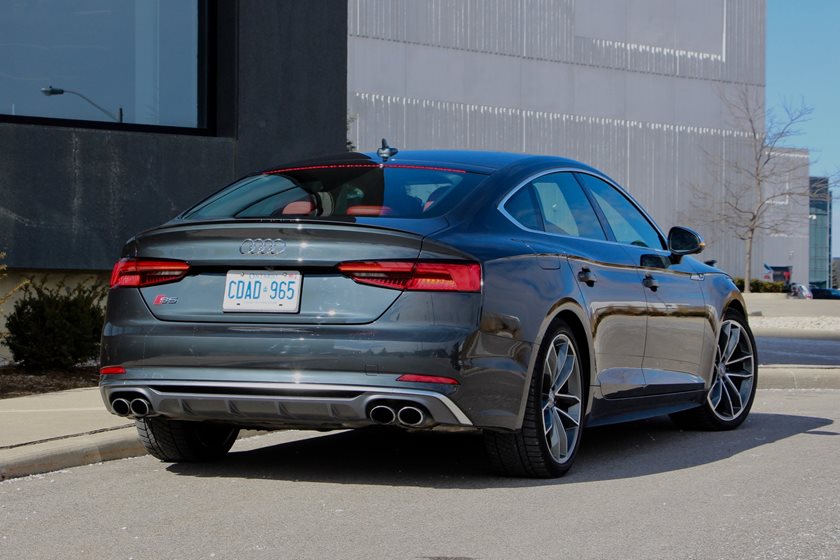
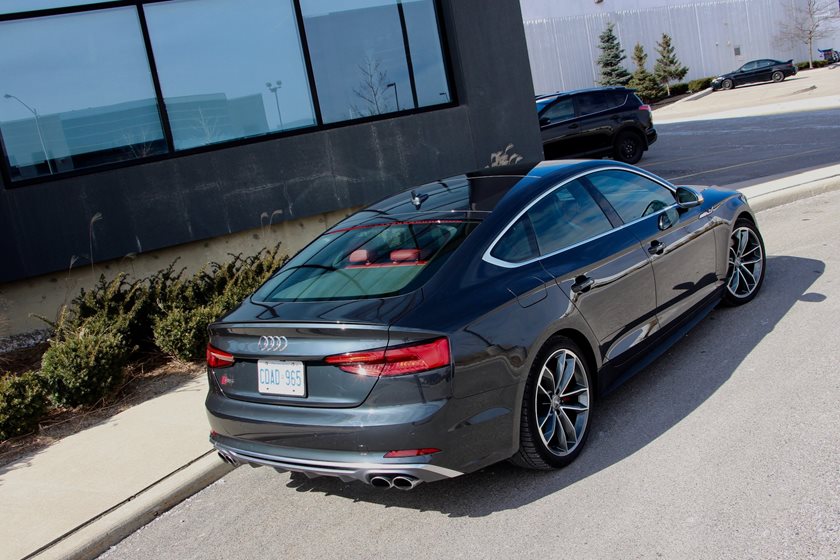
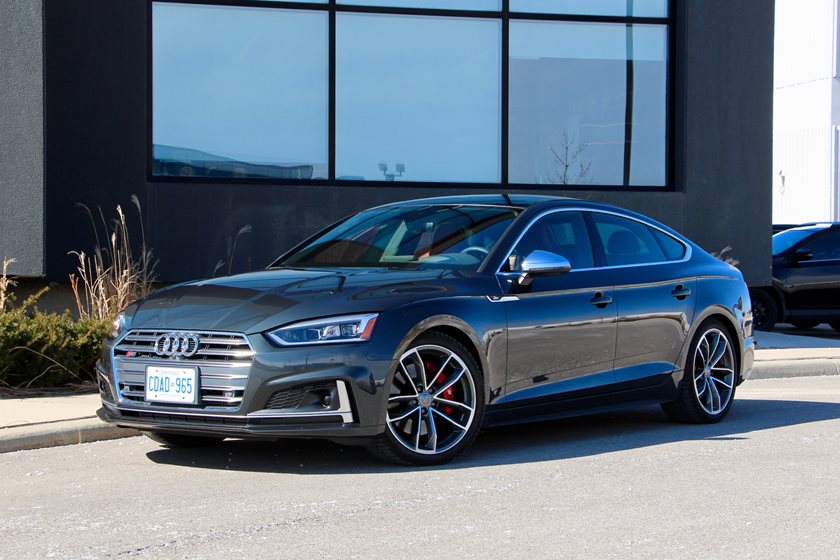
2018 Audi S5 Sportback Test Drive Review: Fast, Fun and Family Friendly

The Audi of choice for a blend of practicality and performance with an emphasis on sport.

Cars are a dying breed you say? Maybe for the masses and the forgotten family sedan, but the luxury segment is booming with new crossover cars that blend the practicality of stigmatized wagons, the styling of a coupe and the profit margins of sports cars. Okay, the four-door coupe segment is still a niche player, but it represents an area of growth and interest in a moribund part of the market.

What Mercedes-Benz started with the CLS four-door coupe in 2005 has spread to all of the German brands' sedans in multiple segments, BMW with the 6 and 4 Series’ Gran Coupes, Audi with the A7 and then A5 Sportback, Volkswagen with the Passat CC, and now even cars as common as the Kia Stinger and Honda Civic borrow that heavily raked C-pillar that defines the breed. I can’t say that most of them appeal to my tastes aesthetically, but in the absence of an A4 or S4 Avant in North America, the 2018 S5 Sportback would easily be my choice in the entire Audi range and fits the sporty family vehicle formula to a tee.

The S4 is that natural athlete in the lineup, and the S5 simply adds a backpack. Okay, Audi will say there’s a bit more to it than that, but that’s good enough for me. The S5 Sportback features a 3.0-liter V6 with Audi TFSI direct injection and twin-scroll turbocharging for 354 hp and 369 lb-ft of torque, and Audi has kept weight under 4,000 pounds at 3,924, so it’s a fair amount of poke for a car that isn’t terribly overweight (if you’re curious, check out the weight of the previous generation S5 convertible). Horsepower peaks between 5,400 and 6,400 rpm, but torque is available pretty much immediately, from 1,370 to 4,500 rpm, so from the moment you get on the gas pedal until you inevitably back off or call up the next gear, it keeps pulling hard.

Audi made a big change in the transmission for this generation, making its eight-speed automatic standard in place of the seven-speed dual clutch and dumping the manual transmission. I loved that manual, and I loved the V8 from the early years of the S5, but progress is a necessity, as is a business case, so the preference of people actually buying these cars is understandable. With all that legacy going against it, the eight-speed Tiptronic does not disappoint. It feels just as fast to swap ratios as the dual-clutch S tronic, the Sport mode is suitably aggressive without being frantically annoying, and it solves the low-speed jerkiness the dual-clutch displayed.

Quattro all-wheel drive does its part, in normal conditions splitting power 40:60 front/rear, but can redirect up to 70% to the front or 85% to the rear, and a self-locking center differential and stability control braking intervention combine for multi-faceted wheel-selective torque control. For the most part, you simply always have grip and acceleration, but a significant leap over previous generations is its greater poise on turn in, and better manipulation of the all-wheel drive and traction control to minimize understeer. Frankly, it’s brilliant, and although I’m sure track testing or a big snowy parking lot would reveal where exactly understeer would rear its ugly head, such an occasion did not present itself.

It was simply grip and rip all week long out of any corner I tossed it into. All of these powertrain tweaks also contribute to a very respectable sprint to 60 mph in 4.5 seconds. It’s not neck-snapping acceleration, but it’s more than adequate for this gentleman athlete type of car, and it’s all very satisfying as a total package. Steering feedback is muted, but it varies from easy in Comfort mode to quicker and heavier in Dynamic mode, and it’s paired with impeccable precision. Every action on the steering wheel in Dynamic seems to elicit the expected degree of turn-in, and the well-damped suspension (which can also be varied between Comfort and Dynamic) keeps the wheels in contact with the road without too punishing a ride.

Starting from the back, the trunk was a joy for me, as it was wide and deep, with all the functional space you’d find in most crossovers - how often does anyone pack their SUVs over the window line anyway? With the seats up it measures 21.8 cubic feet, and the rear seats split 40/20/40, that middle section as good as a ski pass-through for winter-sports families, or a maximum of 35 cu-ft. The coup de grace is the tall opening thanks to the hatchback style, although there is a high lip that heavy cargo would have to be lifted over. Front passengers are treated better because there are only two seats, and they are suitably adjustable for all sizes and shapes, right down to the pneumatic side bolsters and massage function for driver and passenger.

Although there is no breezy ventilation to cool your backside (or heated steering wheel for that matter), the seats are a gorgeous leather, an eye-catching red in our tester (the nappa leather a $1,250 option), and quilted for that added touch of luxury that go along with that sleek, distinctive profile that help make this car feel ‘special.’ That’s a rare feat in cars that cost less than a hundred grand, and the S5 starts at $54,400 (plus $975 freight & PDI on any model), while the less sport-oriented A5 starts at $42,600, although this tester packed on all the dynamic options and landed at a slightly harder to swallow $67,375.

At that price, however, the S5 isn’t just a luxury car and a sports car, it’s also a technological tour de force. Virtual Cockpit turns the gauge cluster into a 12.4-inch screen that can morph to suit your driving tastes or mood, and it's joined by Audi’s intuitive MMI in the center console, with standard Apple CarPlay and Android Auto, not to mention available 4G LTE hotspot and satellite radio. The MMI system is controlled by a scroll wheel and menu buttons, but you can input via the handwriting recognition touchpad. Adaptive cruise control also features traffic jam assist and lane keep assist, which keep you cruising at the pace of traffic, right down to stop-and-go traffic while steering you back into your lane if your attention wanders momentarily.

Navigating parking lots is helped by an overseas view parking display with front and rear distance sensors, plus rear cross traffic alert for exiting parking spots and even a warning to not open your door if the blind spot monitor detects approaching car or bike or pedestrian if you’re parallel parked. And to top it all off, the Bang & Olufsen sound system is excellent. It’s like a Renaissance Man of cars. To go back to my selection of the S5 Sportback as THE Audi to have, I’ll lay out my though process. The A7 and S7 and Q7 are too large and pricey, as is anything above them in the range.

I am a huge fan of the A3 (especially in RS3 guise—love that one-of-a-kind turbo-five), but it is small, and a family of four can fit, but the daily tasks become a bit more of a struggle, from buckling the kids up in a car seat to packing the trunk on a long road trip, and the slightly more practical wagon is only available as the less sporting hybrid. The A4 Allroad is too much to the practical end of the spectrum, as is the Q5, but the SQ5 might certainly be in the running seeing as it’s priced almost identically to the S5 Sportback and has most of the same qualities, with only slightly diminished dynamics.

The A4 and S4 sedans are superb depending on your power needs, but it’s still a sedan with a confined trunk, so it’s a no brainer in my mind to choose the greater cargo space and convenience of the A5 or S5. The A5 Sportback certainly has the convenience, and the power is reasonable, but skip some of the luxury options and you can get the S5 with S sport package for less than $60K, with many of the basic goodies like sport seats and appearance package baked right in.

Although the 2018 Audi S5 Sportback isn’t alone in this segment, facing mainly the 4 Series Gran Coupe, it stands out in a crowd, as proven by numerous thumbs ups from other drivers and people asking questions in parking lots. It doesn’t quite check all the boxes for us wagon-lovers, but it does meet the needs of a fast family and proves itself a stellar performance vehicle for everyday use.

Audi Will Let You Drive These Models For $1,395 A Month

The monthly fee will provide access to the A5 convertible, S5 coupe or Q5 or Q7 crossover.

Audi is the latest automaker to join the car subscription service bandwagon in the US, following the likes of BMW, Volvo, Porsche and Cadillac. Dubbed Audi Select, the new subscription service lets customers swap a selected range of vehicles and provides access to Audi rentals in two dozen domestic markets. There is a catch, though – the service is currently only being trialled at five dealerships in the Dallas-Fort Worth area.

For a fee of $1,395 a month, customers will have access to an A4 sedan, A5 convertible, S5 coupe or Q5 or Q7 crossover. According to Automotive News, subscribers can swap vehicles up to twice a month and hold any vehicle for up to six months.

Like other similar subscription services, the monthly fee includes taxes, maintenance and insurance, but does not cover fuel costs. You also have to be at least 25 years old and hold a valid driver's license free of major moving violations to be eligible.

Audi’s first US subscription service also entitles customers to up to 25 days of Audi rentals annually through Silvercar in 24 markets including New York, Chicago, Los Angeles, Miami, and Denver. Reservations can be booked through the Silvercar app before the car is delivered to you.

While the service is currently only being trialled in Texas, the automaker plans to roll out Audi Select in other markets in the future if the trial is successful. “We do want to do this in other markets, but we need to learn what we need to learn before we move to other markets,” said Audi of America CFO Matt Carpenter. He went on to describe the program as a "new interaction" and said he expects the expansion to be announced by the end of the year.

Monday, 24 June 2019

2019 Audi R8 First Drive Review: More Power, Sharper Suit For Audi's Supercar

Enjoy the Lamborghini V10 while you still can.

There’s no other sports or supercar quite like the Audi R8 – it’s a paradoxical mix of high-tech infotainment and old school V10 engine; of Lamborghini genes and sensible-shoes usability; of searing performance at – in this rarefied segment – a relatively affordable price point. Now Audi has re-booted its mid-engined halo for 2019, admitting all variants to the 200-mph club in the process.

A relatively light tweak it might be, but with Audi rumored to axe the R8 after this second generation or re-imagine it as an all-electric or plug-in hybrid, this is our last chance to enjoy ten cylinders screaming to an incendiary 8,250 rpm.

As before, Coupe or Spyder models are available, both with all-wheel drive, an S-tronic dual-clutch gearbox and that scintillating V10 in two states of tune. When we ask if the cheaper rear-wheel-drive RWS might return, Audi Sport engineers look around nervously and don’t say no. Fingers crossed for that. For now, we’re driving the top-spec coupe: the V10 Performance. With the car still awaiting homologation, we’ve come to the Ascari racetrack in Spain for our drive.

Exterior Design: First Impressions

The changes to the R8 are relatively subtle, but even parked a distance away in the Ascari pit lane it looks different, especially the front: lower and wider, kind of like it’s wearing a mouthguard, but the new jaw is effective in creating a more purposeful look. Look closer and there’s a flatter front grille, three little slits at the leading edge of the hood that recall the Ur Quattro, and a new, wider front splitter.

Changes at the rear are less obvious, with the design team having to draw our attention to the more upswept rear diffuser.

Interior Design And Features

There are two new colors (Kemora Grey, Ascari Blue), new 19-inch alloys (20s for the V10 Performance) and some gloss-black detailing on the standard model, replaced by matte titanium on the Performance.

The interior is unchanged, but plus points include a great driving position, solid build with flashes of flair, and Audi’s virtual cockpit for a slick, modern feel. Important to remember that the Spyder, like before, has a tighter cockpit due to the roof mechanism – if you’re taller than six-feet, you’ll struggle for legroom.

Engine And Performance: Turning The V10 Up To 11

Both versions of the naturally aspirated 5.2-liter V10 get extra power. The standard model now produces 533 hp at 8,250 rpm, an increase of 30 hp, and 406 lb-ft at a high 6,500 rpm, up 7 lb-ft. All of it is purely down to software calibration changes, and helps even the heavier Spyder to score 200 mph.

The Performance we’re driving now produces 612 hp and 428 lb-ft, which is 10 hp / 15 lb-ft stronger than before, and now a little beyond the Lamborghini Huracan too, if not the range-topping Huracan Performante.

These gains come from a valvetrain revised with titanium components as well as fresh ECU mapping. It means the V10 Performance coupe can accelerate from zero to 62 mph in 3.1 seconds and reach 206 mph – one-tenth and 1 mph up on previously.

Revised Chassis

Audi engineers have played around with the chassis, though the basic spring rates and damper specs remain unchanged – there are apparently greater steps between the driving modes, but as we’re driving on track in the Dynamic ‘dry’ setting, we’ll have to wait for another test drive to spot those nuances.

All our test cars are fitted with a new optional anti-roll bar made from carbon fiber and aluminum. It’s laid out next to the standard item in the pit garages and the difference is striking – you could work out with the old one, where the new, 4.5-lb lighter roll bar wouldn’t so much as raise your heartbeat.

The choice of standard or Dynamic steering continues, both updated with calibration changes and available for us to sample. It’s also worth noting that all test cars are fitted with Michelin Cup 2 tires, optional track-focused rubber that you’ll find on a 911 GT3 and Ferrari 488 Pista. No-one at Audi seems to know which markets will be offered these tires.

At The Wheel

Ascari is a fast track, its fear factor multiplied by walls for run-off, blind, heartbeat entries to some corners, and other turns that seem to roll on forever in third and fourth gear, goading you to accelerate earlier than you really should.

Flatten the accelerator in first and the all-wheel drive claws at the pit exit’s dry surface, the V10 rips round past 8,000 rpm while the digital rev counter strobes red in the corner of your eye, and the first to second gear shift thwacks in, full of mechanical menace.

The bare figures tell you performance has moved on with the likes of the McLaren 720S, but this remains visceral acceleration that requires some acclimatisation, even if the small power hike is not particularly obvious.

Standard carbon-ceramic brakes fitted to the Performance (optional for lesser V10s) wipe off speed into the first tight, downhill left-hander – no ABS intervention, big stopping power, maybe a little bagginess at the top of the pedal – and as you aim for the apex, you get a first glimpse of the R8’s sweet balance off-throttle. It turns keenly and with modest, well-supported roll, partly a benefit of the mid-engined layout. But the downhill braking zone exaggerates the weight of the V10 in the back, which starts to swing round – it’s a balance that makes the R8 feel even more nimble and reactive, but it’s definitely a pendulum effect that must be anticipated and nursed.

The stability control’s unintrusive Sport setting and all-wheel drive helps, and under full power as the corner opens and quickens, the nose hooks up and pulls the car out. It switches the balance to a neutral, slightly understeery feeling, and you have to moderate the combination of front-end push and fast-escalating speed. The previous rear-wheel-drive R8 had a more fluid, less manic feeling, but it’s certainly sure-footed. Remember the standard tires will feel less precise on track.

At higher speeds and gears you get more time to appreciate the V10 –the crispness of its response, the linearity of the delivery, but more than anything it’s the bandwidth in the final 1,000 rpm of the rev range and a scream like a distressed chicken that makes the R8 so enjoyable.

The trade is that it feels less enthusiastic at lower revs than a turbo rival and you quickly bog down if you’re a gear too high, but super-quick gear shifts keep you in the power band, even if they do lose the mechanical edge of brutal low-speed acceleration at heartbeat speed.

After a few laps, it’s time to switch into a car with the Dynamic steering, complete with chassis engineer in the passenger seat. He’s candid that he prefers the standard system, but the Dynamic set-up works well, particularly through quick direction changes. There is, however, a less natural sense of support through the long, fast corners, where the slower, heavier feel of the regular steering is preferable. There’s no huge mistake to be made here, but we’d stick with the standard set-up.

Verdict, Prices And Trims

Despite a very mild makeover, the Audi R8 remains a compelling choice, one that’s unfairly overlooked. A McLaren 570S is a lighter, more nimble and more tactile feeling car, but the R8 is cheaper than its British rival and by far the more useable everyday proposition –better refinement, better technology, easier to actually climb into, and offering the security of all-wheel drive and a mainstream dealer network too. And it’s still a relatively safe and invigorating way to explore a racetrack.

More than anything though, the R8 gets our hearts racing because it combines all this level-headedness with a hand built naturally-aspirated Lamborghini V10 that sears and yelps and makes the 570S seem gruff and characterless in comparison. Don’t miss the chance to appreciate it while you still can.

Prices and on-sale dates are TBC, but expect the $165,000 entry model to increase to around $170,000 and the top-spec $194,000 V10 coupe to hit $200,000.

Friday, 31 May 2019

The Most Iconic All-Wheel Drive Cars Of All Time

From the earliest to the quirkiest, we revisit the game-changers.

The all-wheel-drive layout has been part of the motoring scene for almost as long as there has been a motoring scene, but its proliferation into just about every automotive segment is relatively recent. Its most common use was in off-roading vehicles to help improve traction over slippery surfaces. The added complexity and weight did not make such a layout suitable for on-road applications but that didn’t stop engineers from trying. So we thought it'd be interesting to take a closer look at 10 of some of the most relevant AWD vehicles in history.

The Very First 4x4s

The very first AWD car ever built was the 1900 Lohner-Porsche. It was designed by a very young Ferdinand Porsche for Ludwig Lohner & Co. and also has the distinction of being the very first hybrid ever built too. An electric motor in each wheel hub was powered by batteries which received their charge from an onboard gasoline-powered generator. Fiercely complex and ungainly it nevertheless marked the beginning of the 4x4 layout. It was another three years before a more conventional internal combustion engine was to power all four wheels, the car was called the Spyker 60-HP. It featured braking on all four wheels and a six-cylinder engine, both world firsts.

The Quirky Ones

The demand for four-wheel-drive layouts increased exponentially as the years wore on, especially for military vehicles but it wasn’t until 1966 that the first performance car was to make use of an AWD system. This car was the British Jensen Interceptor. Powered by a massive Chrysler V8 it was a rare derivative with only 320 examples finding buyers. The first American-built passenger car to use a 4x4 layout was the 1979 Eagle AMC. Funnily enough, the full-time 4x4 system was provided by a British firm called Ferguson Research. While the Eagle wagon was the most popular you could also get a suitable quirky 4x4 convertible too.

Audi Quattro Revolution

Up until the introduction of the Audi Quattro, the tangible benefits of increased traction and grip 4x4s offered had never been so starkly demonstrated. The relatively simple yet rugged permanent all-wheel-drive system proved to be a game changer in rallying and soon a roadgoing version was introduced. While European versions eventually had up to 217-hp the handful of American imports were somewhat watered down and made only 160-hp. Nevertheless, the Quattro UR marked a turning point in road-going sports cars and its combination of turbocharging and AWD traction has been widely adopted since.

Early AWD Supercars

The limited production 1991 Bugatti EB110 was one of the first supercars to have AWD and this gave the quad-turbo 600-hp supercar serious acceleration off the line. The Modern-day Chiron is in many ways a descendant of this original AWD monster. The slightly mad LM002 off-roader introduced in 1986 was the first Lamborghini to come equipped with AWD but it was the V12 Diablo that first used this technology to improve on-road performance. The 1993 Diablo VT could channel up to 25% of engine torque to the front wheels which made this fearsome beast a bit more manageable at the limit. Except for a few limited-edition models, modern Lamborghinis are almost always fitted as standard with AWD. With up to 740-hp available from the current Aventador SV, this is definitely a good thing.

Nissan GT-R Domination

The GT-R may have started off as a rear-wheel-drive sedan but the more modern iterations all had complex AWD systems that gave them the ability to take on and often beat much more powerful and expensive supercars. The current GT-R is into its 10th year of production yet its acceleration off the line is still comparable with the latest crop of supercars. Continual updates and improvements are partly responsible for this impressive performance but it is the AWD system that provides it with the necessary grip to deploy 600-hp effectively. Modified examples producing close on 2000-hp have been built, showcasing the inherent toughness of the standard car.

BMW M5 U-Turn

BMWs have long been touted as the ‘ultimate driving machines’ primarily due to their 50:50 weight distribution and rear-wheel-drive layouts. The continual rise in power outputs has meant that some of the latest M models are a bit of a handful when trying to deploy all of that ultimate driving excitement. Enter the latest M5, equipped with a switchable AWD system, it offers the best of both worlds. Despite making no more power than the outgoing model it can launch to 60mph almost a second quicker. Turn it back to 2WD mode and you can slide around every corner just like you could in the old car.

AWD Ferrari GT

Ferrari developed a unique AWD system for their FF GT car back in 2011. Featuring a secondary gearbox and Haldex clutches that transmitted power to the front wheels in lower gears, the car remained primarily rear-wheel driven but would provide additional traction when conditions required. Its replacement, the GTC4 Lusso retained the system in the top V12 variant and remains a superb GT car. This sort of tech may well find its way into other Ferrari products in the future although no official announcements have yet been made.

Porsche 918 Spyder

One of the original hybrid hypercar trio, the Porsche 918 was the only one to feature AWD and it proved to be the fastest to 60 mph of the lot. Its 2.5-second time is still at the very pointy end of what the latest batch of supercars and hypercars can manage. Aside from the ground-breaking technology required to make a hybrid hypercar, the AWD system has also been designed to work even when the 918 is being powered by the electric motors alone. Porsche has utilized AWD technology in cars like the ‘80s 959 supercar to good effect before and it is quite likely that its new generation of hybrid and all-electric vehicles will continue with this trend going forward.

Ariel Madness

Fast AWD cars are nothing new these days, there are powerful versions of just about everybody style and configuration around. The Ariel Nomad, however, is a rather special car as it takes the minimalist approach of the Ariel Atom and translates it into an off-road capable package. The result is one of the very fastest production off-roaders on the planet.

Acceleration times are V8 sportscar quick and can be attained on a variety of road surfaces. Such single-minded leisure-based vehicles are very popular these days and the Nomad comes with the backing and engineering pedigree of an established company to boot.

The Future of AWD? The Zarooq Sand Racer

The Sandracer 500GT is promoted as being the first Emirati car ever and it promises a carbon-fiber body construction, Corvette-sourced 6.2-liter 525-hp V8 and the ability to flatten even the most daunting of sand dunes with ease.

Production numbers will be kept low and the pricing will reflect its supercar-for-the-dunes aspirations. Not much more is known from this potential off-roading disruptor, but we hope that things are still on track as it looks fantastic and that pesky little Ariel Nomad could do with some stiff competition.