Showing posts with label Etron. Show all posts

Monday, 2 September 2019

Audi Shows Us Inside E-Tron Prototype For The First Time

It looks pretty slick... and about ready for production.

Audi is busy preparing its first fully electric vehicle for production. And for the time being, it's still keeping the exterior shape of the crossover under wraps. But now it's shown us around inside for the first time. Showcased at the Royal Danish Playhouse in Copenhagen, the Audi e-tron prototype rides on a wheelbase 2,928 millimeters (9.6 ft) long – just 66 mm (2.6 inches) shorter than the Q7's. That gives it ample room inside for five passengers (no third row here) and their stuff – all riding in a quiet atmosphere with no engine noise to invade the cabin.

All the occupants are likely to hear is the quiet hum of the electric motors and the wind noise. But even that's been reduced by the absence of door mirrors. Those have been replaced (as an option) by digital cameras – a feature that's been a long time coming to automobiles, but will be put into production for the first time in the e-tron. That is, at least, where local regulations allow it. So we wouldn't count on them featuring on the US version just yet. With no driveshaft intruding into the cabin, the rear floor is also completely flat. But there's more to the e-tron's interior than what it doesn't have. As you might expect, Audi has crafted a suitably modern – even futuristic cabin environment for its debut EV.

The interior design is dominated by horizontal lines for an expansive, open look and feel, with a “floating” armrest, fully digital dashboard, and optional ambient lighting and orange piping and stitching. Audi has also partnered with Bang & Olfusen on the 3D-sound system, with 16 speakers and a 705-watt amplifier to deliver concert-quality audio. Despite its “prototype” label, the e-tron's interior looks production-ready. Once Ingolstadt is ready to unwrap it, the electric crossover will take on the likes of the Tesla Model X and Jaguar I-Pace. Judging from the length of its wheelbase, it'll be about the same size, and will likely carry a similar price tag starting around $70k (in the US) or €80k (in Europe).

Tuesday, 20 August 2019

The Wait Is Over: Audi e-tron Sparks Germany's Green Car Revolution

Sorry Tesla, Goliath has finally woken up.

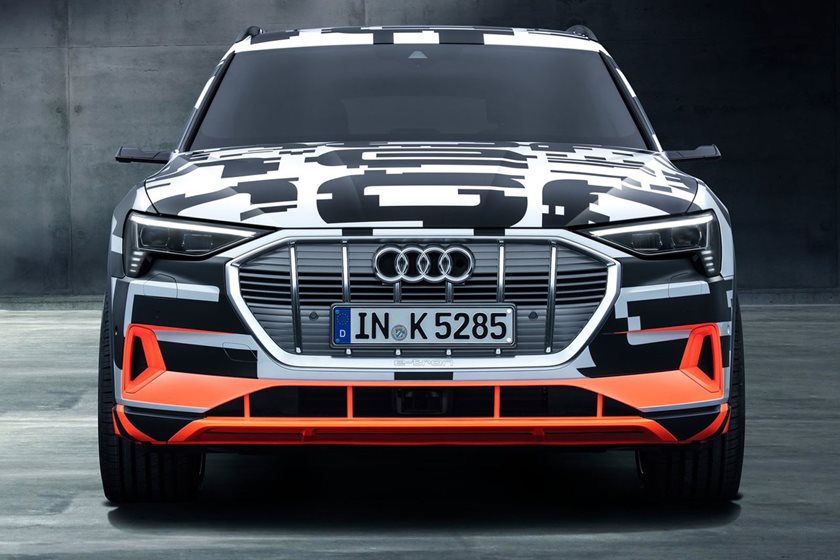
San Francisco’s worn out streets have borne witness to more boom and bust cycles than just about any other city in America. It seems as if every time some figures out how to print money, whether by panning for gold or writing lines of code, the dreamers among us flock to these hill-ridden streets to make our fortunes. But the 1,800 journalists that Audi flew in from around the world for the world premiere of the e-tron had no dollar signs in their eyes, just the same bewitching look of curiosity that led them to commit to this trade in the first place. And there’s a good reason for our obsession too. Given that most of the e-tron’s fact sheet has already found its way online, Audi has been itching to show off the physical manifestation of those numbers without that tacky camouflage ruining the gorgeous body lines.

And boy are they gorgeous. Unlike BMW’s Vision iNEXT, Audi thought the best way to attract customers to the electric revolution would be to make its world-beating EV look, well, attractive. Donning the body style best suited to push the e-tron from dealerships to driveways in droves, this battery-powered crossover takes full advantage of its powertrain by sending the front and rear axles to the ends of the vehicle. Without the need for a fire-breathing engine in the engine bay, the hood line can remain low and the overhangs short.

Despite a roomy greenhouse, the e-tron’s visually wide stance and gradually tapering rear give the impression that the EV is crouching, probably on the prowl for Teslas it can eat for breakfast. Angled headlights and a large octagonal grille with active shutters (used to cool electronic components) perfectly define the word “confidence” while the taillights, which have been merged together by a thin lighting strip, make it so those stuck behind the e-tron in traffic will have some eye candy to console themselves with.

Getting stuck behind the e-tron is an event that other road goers will have to contend with frequently given the e-tron’s powerful but whisper-quiet grunt. In order to earn its famed quattro badge, engineers loaded the e-tron with two electric motors, one behind the centrally-mounted battery pack that pushes 187 horsepower to the rear wheels and another up front sending 167 horsepower to the front tires.

System total sits at 354 ponies, but that number can temporarily jump to 401 horsepower for ten seconds by increasing the front motor’s output to 214 horsepower—a feat that brings the motor’s heat levels to the outer edges of what engineers are comfortable with. With that kind of power, the e-tron can accelerate from 0-60 mph in 5.5 seconds. Unlike Tesla, Audi doesn’t manage its 250 miles of range (on the European test cycle, EPA numbers have yet to surface) by sticking hundreds of AA-sized batteries under the floor in a cell formation.

The engineers still placed the 1,541-pound battery in the floor so the e-tron can remain friendly with the laws of physics, but it contains its juice within 36 modules, each with 12 battery cells inside. As a luxury brand, Audi must adhere to the high demands of customers who want cutting edge electrification without compromise. To meet expectations, engineers ensured that the e-tron’s dual braking system, which includes standard disc brakes as well as a highly sophisticated regenerative braking system, feels like a single entity rather than two separate braking systems.

It’s the norm for electric cars to induce range anxiety within buyers accustomed to quick fill-ups at gas stations. Since making cars is one feat and building an infrastructure to keep them rolling is another, Audi has partnered with a company called Electrify America to keep the e-tron juiced during trips around town and during cross-country road trips.

Electrify America already has 50 charging stations in most major cities and along the I-80 and I-10, but plans to have 500 stations in the US by July of 2019. Charging the e-tron won’t take long thanks to the 150 kW charging capability that allows for the battery to reach 80% with only 30 minutes of charging. Navigating to charging stations will be made easy by Audi’s new infotainment system. By placing a wireless phone charger where the MMI knob used to be, Audi will force buyers to rely on a dual-touchscreen system for interaction with the car’s electronics. Until we spend more time with the system, we can’t say whether Audi has shot itself in the foot or started a revolution by ditching the knob-based MMI system. To its credit, the screen does seem to require assertive presses that respond with the same satisfying click we’ve learned to expect from the rest of Audi’s cockpit buttons.

There are certainly a lot of screens because Audi has replaced the e-tron’s side mirrors with cameras and two OLED displays, one sitting below each A-pillar. While the system won’t be available to us Americans until regulators approve it, it feels intuitive and easy to use—the driver’s side screen doubles as a touchscreen that controls the display angle of each mirror.

If all those batteries and OLED displays sound expensive, you’re not wrong. Remember, the e-tron may be a Tesla killer, but it’s not gunning for the Model 3. As such, you won’t be able to walk out of the Audi dealership with one for less than $74,800 for a Premium Plus model. The Prestige model, which gets massaging seats and the driver assistance package, starts at $81,800 while Edition One, reserved for the first US buyers, starts at $86,700.

Though Audi won’t deliver the e-tron until the second quarter of 2019, you can preorder one now without being afraid that production delays will keep it from getting to your driveway this century.

Friday, 16 August 2019

Want To Buy The New Audi e-tron? It'll Cost You Around $100,000

Audi's first EV will have a base price of 80,000 Euros in Germany.

Earlier this month at the Geneva Motor Show Audi unveiled its e-tron concept, and aside from the slightly camouflaged exterior, it’s nearly production ready. Audi’s first all-electric model will be an SUV that’s directly aimed at the Tesla Model X and it’s set to launch in the European market at the end of this year. And like the Model X, it won’t exactly be cheap. According to InsideEVs, Audi announced pricing for the production-spec e-tron SUV in Germany, where buyers will be asked to fork over at least 80,000 euros, or around $98,445 USD.

Once it goes on sale in the US, expect the base price to be around $100,000. And you know what? That’s actually a fair price, if you take the Model X into account. The Model X 100D starts at around $97,000 while the top-of-the-line P100D costs about $140,000. Audi has yet to delve into specifics regarding the e-tron’s range and other relevant factors, but we can expect it (along with the new Jaguar I-Pace) to be the Tesla’s most serious rival to date. The e-tron will also be just first of a range (no pun intended) of new Audi EVs. Starting in 2019, Audi plans to have three all-electric vehicles in its lineup, including the just announced four-door Gran Turismo.

By 2025, Audi has plans to launch more than 20 electric cars and plug-in hybrids. At the moment, the e-tron is undergoing final testing by conducting test drives on four continents where every type of extreme weather and terrain can be found. The Audi e-tron, based on the hype and concept alone, is already gathering orders. For example, Audi has already received 3,700 reservations from Norway alone. Not surprisingly, Norway also happens to be one of Tesla’s best-selling markets.

Wednesday, 14 August 2019

Audi e-tron Enters Production Ahead Of World Debut

Audi will lift the covers off the e-Tron in just two weeks.

This week is an important week for the EV industry as Mercedes will be debuting its first electric vehicle, the Tesla-fighting EQC. Its main competitor, the Audi e-tron, is slightly late to the party, however. Originally, Audi was going to lift the covers off the e-tron last month, but the arrest of the automaker’s CEO has delayed the reveal event until September 17th in San Francisco, several weeks after the Mercedes EQC debuts.

To temporarily distract us from the Mercedes EQC’s forthcoming reveal, Audi has announced the e-tron has entered production at the company’s factory in Brussels two weeks before the electric SUV’s world debut. A new teaser shot shows the automaker’s first ever all-electric vehicle hiding under a sheet with a small section uncovered showing the LED headlights and front fascia finished in Misano Red.

Since the summer of 2016, Audi has extensively rebuilt its body shop, paint shop and assembly line and also set up its own battery production to prepare for the Audi e-tron’s series production. Thanks to Audi’s extensive teaser campaign, we already know what to expect from the e-Tron. The automaker has confirmed the e-Tron will utilize two electric motors developing a combined output of 355 horsepower and 414 lb-ft of torque. Activating the boost mode increases the output to 402 hp and 490 lb-ft of torque for up to eight seconds.

Thanks to its large 95-kWh battery pack, the eTron will also offer a range of over 248.5 miles in the WLTP cycle and hit 0-62 mph in less than six seconds. It will be the first production vehicle to feature side cameras instead of conventional door mirrors. Suffice to say, there probably won’t be many new details left to reveal since the production model is expected to closely resemble the e-tron prototype. Nevertheless, as one of the most important model launches in Audi’s history, the e-tron has a lot to live up to, so we’re eager to see if the final production model can deliver.

Friday, 9 August 2019

The Wait Is Over: Audi e-tron Sparks Germany's Green Car Revolution

Sorry Tesla, Goliath has finally woken up.

San Francisco’s worn out streets have borne witness to more boom and bust cycles than just about any other city in America. It seems as if every time some figures out how to print money, whether by panning for gold or writing lines of code, the dreamers among us flock to these hill-ridden streets to make our fortunes. But the 1,800 journalists that Audi flew in from around the world for the world premiere of the e-tron had no dollar signs in their eyes, just the same bewitching look of curiosity that led them to commit to this trade in the first place. And there’s a good reason for our obsession too. Given that most of the e-tron’s fact sheet has already found its way online, Audi has been itching to show off the physical manifestation of those numbers without that tacky camouflage ruining the gorgeous body lines.

And boy are they gorgeous. Unlike BMW’s Vision iNEXT, Audi thought the best way to attract customers to the electric revolution would be to make its world-beating EV look, well, attractive. Donning the body style best suited to push the e-tron from dealerships to driveways in droves, this battery-powered crossover takes full advantage of its powertrain by sending the front and rear axles to the ends of the vehicle. Without the need for a fire-breathing engine in the engine bay, the hood line can remain low and the overhangs short.

Despite a roomy greenhouse, the e-tron’s visually wide stance and gradually tapering rear give the impression that the EV is crouching, probably on the prowl for Teslas it can eat for breakfast. Angled headlights and a large octagonal grille with active shutters (used to cool electronic components) perfectly define the word “confidence” while the taillights, which have been merged together by a thin lighting strip, make it so those stuck behind the e-tron in traffic will have some eye candy to console themselves with.

Getting stuck behind the e-tron is an event that other road goers will have to contend with frequently given the e-tron’s powerful but whisper-quiet grunt. In order to earn its famed quattro badge, engineers loaded the e-tron with two electric motors, one behind the centrally-mounted battery pack that pushes 187 horsepower to the rear wheels and another up front sending 167 horsepower to the front tires.

System total sits at 354 ponies, but that number can temporarily jump to 401 horsepower for ten seconds by increasing the front motor’s output to 214 horsepower—a feat that brings the motor’s heat levels to the outer edges of what engineers are comfortable with. With that kind of power, the e-tron can accelerate from 0-60 mph in 5.5 seconds. Unlike Tesla, Audi doesn’t manage its 250 miles of range (on the European test cycle, EPA numbers have yet to surface) by sticking hundreds of AA-sized batteries under the floor in a cell formation.

The engineers still placed the 1,541-pound battery in the floor so the e-tron can remain friendly with the laws of physics, but it contains its juice within 36 modules, each with 12 battery cells inside. As a luxury brand, Audi must adhere to the high demands of customers who want cutting edge electrification without compromise. To meet expectations, engineers ensured that the e-tron’s dual braking system, which includes standard disc brakes as well as a highly sophisticated regenerative braking system, feels like a single entity rather than two separate braking systems.

It’s the norm for electric cars to induce range anxiety within buyers accustomed to quick fill-ups at gas stations. Since making cars is one feat and building an infrastructure to keep them rolling is another, Audi has partnered with a company called Electrify America to keep the e-tron juiced during trips around town and during cross-country road trips.

Electrify America already has 50 charging stations in most major cities and along the I-80 and I-10, but plans to have 500 stations in the US by July of 2019. Charging the e-tron won’t take long thanks to the 150 kW charging capability that allows for the battery to reach 80% with only 30 minutes of charging. Navigating to charging stations will be made easy by Audi’s new infotainment system. By placing a wireless phone charger where the MMI knob used to be, Audi will force buyers to rely on a dual-touchscreen system for interaction with the car’s electronics. Until we spend more time with the system, we can’t say whether Audi has shot itself in the foot or started a revolution by ditching the knob-based MMI system. To its credit, the screen does seem to require assertive presses that respond with the same satisfying click we’ve learned to expect from the rest of Audi’s cockpit buttons.

There are certainly a lot of screens because Audi has replaced the e-tron’s side mirrors with cameras and two OLED displays, one sitting below each A-pillar. While the system won’t be available to us Americans until regulators approve it, it feels intuitive and easy to use—the driver’s side screen doubles as a touchscreen that controls the display angle of each mirror.

If all those batteries and OLED displays sound expensive, you’re not wrong. Remember, the e-tron may be a Tesla killer, but it’s not gunning for the Model 3. As such, you won’t be able to walk out of the Audi dealership with one for less than $74,800 for a Premium Plus model. The Prestige model, which gets massaging seats and the driver assistance package, starts at $81,800 while Edition One, reserved for the first US buyers, starts at $86,700.

Though Audi won’t deliver the e-tron until the second quarter of 2019, you can preorder one now without being afraid that production delays will keep it from getting to your driveway this century.

Wednesday, 7 August 2019

764-HP Audi PB18 e-tron Concept Is The Driver-Focused Electric Supercar Of Our Dreams

The cockpit can be switched from a two-person layout to a single-seater for track driving.

We’re so used to seeing futuristic-looking concept cars designed to showcase advanced autonomous driving technology that Audi’s latest concept car is wholly refreshing. Presented at Pebble Beach, the Audi PB18 e-tron Concept is devoid of self-driving technologies. Instead, Audi has focused on the driving experience to show what the driver-focused electric supercar of our dreams could look like in the future.

Three electric motors power the car, with a 201-hp unit at the front and two other motors powering the rear wheels providing an additional 604 hp. Drive it conservatively, and the concept delivers a combined power output of 671 hp and 612 lb-ft of torque, but peak power of 764 hp is possible in short bursts, allowing the concept to hit 0-62 mph in a little over two seconds.

As well as being powerful, the concept has also been designed to be extremely efficient. While being driven, the Audi PB18 e-tron recovers large amounts of energy as the electric motors are solely responsible for slowing the car down during moderate braking, with the hydraulic brakes taking over for heavy braking. Having separate electric motors on the rear axles has also allowed Audi to implement a Torque Control Manager to enhance the car’s sporty handling. Working with the Electronic Stabilization Control, this system actively distributes the power to the wheels of the front and rear axles when needed for maximum stability and driving pleasure.

In terms of design, the PB18 e-tron's striking shape is inspired by Audi’s successful R18 e-tron quattro Le Mans race car and features a similar suspension setup combining push-rods on the front axle with pull-rods at the rear with magnetic ride shock absorbers. The wheels measure 22 inches in diameter and are fitted with 275/35 tires in the front and 315/30 in the back. Large carbon brake discs with a 19-inch diameter provide significant stopping power in conjunction with the electric brake.

The interior is also very futuristic as the cockpit can be switched from a two-person layout to a single-seater configuration for track driving. With the latter setup, the driver is cocooned in the center of the cockpit. The windshield also incorporates an augmented reality system that displays information such as the ideal racing line. Sadly, Audi isn’t planning to put the PB18 e-tron into production, but we’re hoping it will one day inspire a future halo car to showcase the technology of Audi's electric e-tron range.

Friday, 19 July 2019

The Electric Audi e-tron Will Seamlessly Connect To Your House

You’ll be able to charge the Audi E-Tron using your home’s electric infrastructure.

In just a couple of months Audi will unveil the e-tron, the German automaker’s first foray into the electric SUV segment. As its debut draws closer, Audi has revealed how the technically-advanced SUV will be able to seamlessly connect to your house thanks to a partnership with SMA Solar Technology and the Hager Group that will enable “intelligent interaction with home energy management systems” and “cost-optimized charging” to combat the lack of proper charging networks.

The standard compact charging system will feature charging with an output of up to 11kW. An optional connect charging system will double that output to 22kW, for which the e-tron will be equipped with a second, optional charger. The connect charging system will be able to connect to the infrastructure via the home’s WiFi and offer “intelligent charging functions” in conjunction with a home energy management system. “In keeping with our premium quality standards, we want an electric car that fits seamlessly into the intelligently connected home, to provide genuine added value for the customer," said Fermin Soneira, Head of Product Marketing at Audi.

"That is why we have teamed up with the two leading suppliers of home energy management systems, the Hager Group and SMA Solar Technology. That brings maximum charging convenience.” With the connect charging system and a suitably equipped home energy management system, owners will be able to use variable electricity tariffs to charge the Audi e-tron. If the home is fitted with a photo-voltaic system, the charging process can be optimized to prefer the electricity generated by the system for charging their vehicle. The final production version of the Audi e-tron will be unveiled in Brussels on August 30.

Audi is touting a range of 249 miles and the SUV is expected to be powered by a pair of electric motors and a 95kWh battery generating around 400 hp.

Thursday, 18 July 2019

Audi Shows Us Inside E-Tron Prototype For The First Time

It looks pretty slick... and about ready for production.

Audi is busy preparing its first fully electric vehicle for production. And for the time being, it's still keeping the exterior shape of the crossover under wraps. But now it's shown us around inside for the first time. Showcased at the Royal Danish Playhouse in Copenhagen, the Audi e-tron prototype rides on a wheelbase 2,928 millimeters (9.6 ft) long – just 66 mm (2.6 inches) shorter than the Q7's. That gives it ample room inside for five passengers (no third row here) and their stuff – all riding in a quiet atmosphere with no engine noise to invade the cabin.

All the occupants are likely to hear is the quiet hum of the electric motors and the wind noise. But even that's been reduced by the absence of door mirrors. Those have been replaced (as an option) by digital cameras – a feature that's been a long time coming to automobiles, but will be put into production for the first time in the e-tron. That is, at least, where local regulations allow it. So we wouldn't count on them featuring on the US version just yet. With no driveshaft intruding into the cabin, the rear floor is also completely flat. But there's more to the e-tron's interior than what it doesn't have. As you might expect, Audi has crafted a suitably modern – even futuristic cabin environment for its debut EV.

The interior design is dominated by horizontal lines for an expansive, open look and feel, with a “floating” armrest, fully digital dashboard, and optional ambient lighting and orange piping and stitching. Audi has also partnered with Bang & Olfusen on the 3D-sound system, with 16 speakers and a 705-watt amplifier to deliver concert-quality audio. Despite its “prototype” label, the e-tron's interior looks production-ready. Once Ingolstadt is ready to unwrap it, the electric crossover will take on the likes of the Tesla Model X and Jaguar I-Pace. Judging from the length of its wheelbase, it'll be about the same size, and will likely carry a similar price tag starting around $70k (in the US) or €80k (in Europe).