Showing posts with label still. Show all posts

Wednesday, 24 July 2019

Cars You Didn't Know Still Came With A Manual Transmission

The manual transmission is dying, but a few cars still offer them.

The manual transmission is on the verge of dying out. Today, only 3 percent of new cars in the US are even sold with one. There are a few enthusiast models like the Ford Focus RS and Subaru WRX STI that are only available with a manual, but most cars don't even offer it as an option anymore. There have always been a few oddball cars that most people never knew came with a manual, and that trend continues today. We have compiled our list of the five new cars that almost no one knows are still available with a third pedal.

Audi broke our hearts when it announced that the newest S4 would no longer be offered with a manual transmission, deciding instead to replace the car's dual-clutch with a conventional automatic. Luckily, the standard A4 still comes with a seven-speed dual-clutch and an optional six-speed manual transmission. The A4's 2.0-liter turbocharged four-cylinder produces 252 hp and 272 lb-ft of torque going out to Quattro AWD. The A4 with a manual transmission is an incredibly fun car, and we wish that more sport sedans still offered a third pedal. We are talking to you Alfa Romeo.

One of the problems with modern manual transmissions is that some automakers only offer them on the base engine or the top of the line engine. The Jeep Renegade is an example of the former. We thought that the Jeep Renegade was a pretty competent off-roader, but that was with the optional 180 hp 2.4-liter engine, nine-speed automatic and AWD. You can get the Renegade with a six-speed manual, but only with the smaller, 160-hp 1.4-liter turbocharged engine with front-wheel-drive. Sadly, this kind of ruins any off-roading ability that the Renegade possesses and makes it incredibly slow.

Honda has long been a company that has offered otherwise pedestrian cars with fun manual transmissions. Even if your wife or parents wouldn't let you have a sports car, you could always get a nice Honda with a slick manual transmission. Honda continues to offer a six-speed manual on its small HR-V crossover. This definitely makes the HR-V more interesting, but is still powered by a lackluster 1.8-liter four-cylinder that produces only 141 hp. We'd love to see Honda drop in the 1.5-liter turbocharged engine from the Civic, keep the manual and create a sporty HR-V Si.

We have always loved the Subaru Crosstrek. For the 2018 model year, Subaru decided to pull back a bit on the Crosstrek's wacky styling in favor of a more conventional design. Luckily, Subaru now offers the Crosstrek with a six-speed manual transmission, which replaces the older five-speed unit. Unfortunately, the car is only available with one engine, a 2.0-liter flat-four with 152 hp. Like the HR-V, the Crosstrek could really benefit form a turbocharged engine with more power.

The last spot on our list is actually taken up by an entire car company. Mini is actually the last automaker in the world that offers a manual transmission on every model in its lineup. That's right, Mini is the only automaker that lets you pick any engine, any drivetrain, and trim and still get a manual transmission. We absolutely love Mini for this, but we wish that its parent company BMW still offered more manuals on its models.

Thursday, 23 May 2019

Audi Is About To Get A New CEO Because Its Current One Is Still Locked Up

The fallout from Dieselgate continues.

Current and apparently soon to be outgoing Audi CEO Rupert Stadler is at this very moment sitting in jail. He was arrested last month following allegations he attempted to tamper with evidence during the Volkswagen Dieselgate investigation. It doesn’t seem like he’ll be released anytime soon and even if were, it’s not like he can go back to his job as if nothing happened.

Perhaps that’s why, according to Automotive News, the Volkswagen Group is about to appoint BMW purchasing director Markus Duesmann as Audi’s next CEO, effective January 1, 2019. It’s not particularly surprising to hear of a high-level executive being poached by a rival brand.

In fact, current Volkswagen CEO Herbert Diess also worked at BMW as purchasing chief until 2015. But why won’t Duesmann start work at Audi earlier? Supposedly it’s because his current contract with BMW doesn’t expire until sometime in the fall and it includes a clause preventing him from going to work for a rival immediately. There’s a short cooling off period it seems.

Duesmann is a mechanical engineer by training and has worked at BMW since 2007. Before that, he worked at Mercedes-Benz as head of Formula 1 powertrain. As for Stadler, well… Volkswagen and Audi rightly claim he’s innocent until proven guilty but the legal process isn’t likely to end anytime soon. Will his case go to trial? Will he strike a plea bargain?

These are questions that can’t be answered and Audi needs to continue going about business as usual. Its sales chief, Bram Schot, is currently filling in as interim CEO until Duesmann is able to get started. Fortunately for Audi, sales remain stellar. Only a few weeks ago did it report that worldwide deliveries increased by 4.5 percent since the start of the year for a total of 949,300 units.

(function(w,d,s,l,i){w[l]=w[l]||[];w[l].push({'gtm.start':new Date().getTime(),event:'gtm.js'});var f=d.getElementsByTagName(s)[0],j=d.createElement(s),dl=l!='dataLayer'?'&l='+l:'';j.async=true;j.src='https://www.googletagmanager.com/gtm.js?id='+i+dl;f.parentNode.insertBefore(j,f);})(window,document,'script','dataLayer','GTM-MJCGS3N');var _comscore = _comscore || [];_comscore.push({ c1: "2", c2: "28140907" });(function() {var s = document.createElement("script"), el = document.getElementsByTagName("script")[0]; s.async = true;s.src = (document.location.protocol == "https:" ? "https://sb" : "http://b") + ".scorecardresearch.com/beacon.js";el.parentNode.insertBefore(s, el);})();

Sunday, 31 March 2019

Here's Every V12-Powered Car Still In Production

Surprisingly, downsizing hasn't affected the V12 sector much.

In the age of downsizing, it would be fair to assume that the V12 would be one engine lost to the times, with modern turbocharged V8s offering comparable power outputs, let weight, and thus, greater performance. But surprisingly enough, the V12 engine isn’t as dead as you might think, with no less than 18 models still in production making use of the configuration, hailing from 7 different manufacturers. While others may struggle with the effects of downsizing, these 7 manufacturers, gods of the industry, continue to produce some of the most glorious 12-cylinder motors around.

Aston Martin

It’s no surprise that Aston Martin feature on this list, and they do so in grand fashion with 4 models featuring a V12. Though the rather small-scale sports car brand from England may have signed a deal with Mercedes to utilize AMG V8s, at this stage their V12s are their own.

The DB11 and DBS Superleggera are based on effectively the same vehicle, though using Mercedes wiring and electronics, the 5.2-liter bi-turbo V12 is developed and built in-house, producing an impressive 600 horsepower in DB11 guise. But with the recently unveiled DBS Superleggera, Aston have turned the dial way up to 11, with the Superleggera’s version of the same V12 generating 715hp all sent to the rear wheels. It may not be lightweight as its name suggests, but that’s nothing a little power can’t fix.

Two of Aston’s older models still feature V8s too, though how long these two models have left in production is uncertain. The Vanquish S and its convertible counterpart both make use of a V12 engine, 5.9 liters in displacement and generating 565hp to go along with it But the Vanquish S is known to be the Vanquish’ last hurrah before it ends production, so this one may be dying off soon.

The last aging Aston with a V12 powerplant is the Rapide S. When it comes to luxury sedans, Aston is a brand seldom thought of. Admittedly, the Rapide S does a somewhat poor job of being a luxo-barge against the current crop from Mercedes, BMW, and the likes of Porsche even. However, the Rapide S has a definite driver focus, and the V12 engine is central to that impression. Delivering 552hp from its 5.9-liter displacement, it’s a potent piece of kit that gives the Rapide S unmistakable presence.

BMW

BMW is one brand to have wholeheartedly invested in downsizing. Just look at the i8 sports car with a 3-cylinder engine or the fact that the M3 dropped from a V8 to an inline-6. For most high-power applications for the brand, a twin-turbo V8 is more than enough to get the job done. But when it comes to its halo of luxury and performance, a mere V8 simply wouldn’t do; which is why in the range-topping M760i xDrive, BMW has equipped a 602hp bi-turbocharged 6.6-liter V12, driving all 4 wheels through an 8-speed automatic gearbox. The V12 offers superb refinement, but even more astounding is the performance, shunting the massive limousine from 0-62mph in 3.9 seconds.

Ferrari

Ferrari is famous for its use of front-mounted V12 engines in its big grand tourers. In fact, for the longest of times, there wasn’t a Ferrari built without a front-mounted V12 – at least until Enzo Ferrari shook things up. At present, two Ferraris are available for order with V12 powerplants. The GTC4Lusso packs a front-mid mounted 6.3-liter naturally aspirated V12. In a unique twist, it drives all 4 wheels via a twin-gearbox setup, making full use of the 681hp to make the hatchback Ferrari immensely quick in all weather conditions. But the Lusso hasn't escaped downsizing, as there is a V8 turbocharged version too.

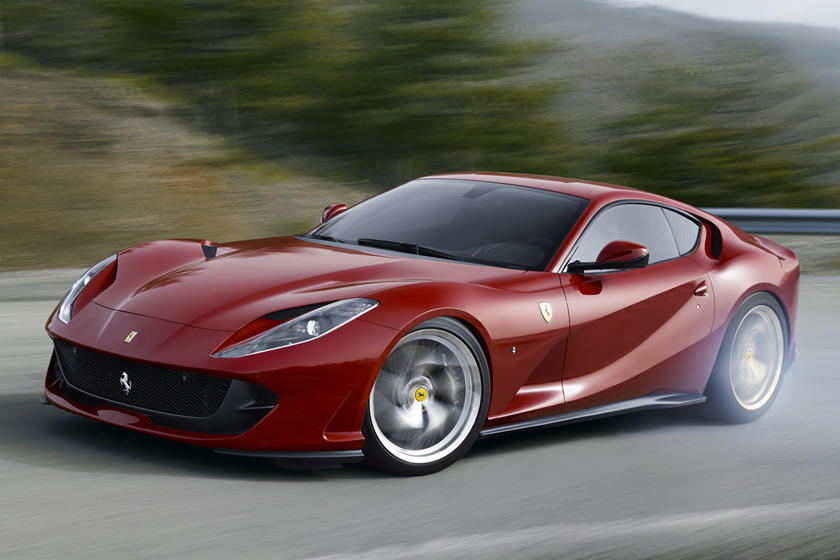
The 812 Superfast utilizes a front mid-mounted advancement of the GTC4Lusso’s V12, with displacement increased to 6.5-liters and power uprated to an astounding 789hp. Drive goes solely to the rear wheels through a dual-clutch transmission. Though the 812 Superfast is the most powerful unassisted Ferrari ever produced (only the LaFerrari offers more power), its primary role is as a GT car, not an all-out supercar. While there have been doubts as to whether Ferrari will continue with the V12 engine, the 812 Superfast is a reassuring commitment to the engine so steeped in the brand’s history.

Lamborghini

Lamborghini’s history is one entangled with Ferrari right from the very beginning. Though there have been V8-powered Lambos through the years, they’ll always be known for their insane V12-powered monsters that defined, and redefined the supercar genre time and time again. It should come as no surprise then that the brand is still showing their commitment to the V12 with the Aventador S. Powered by a mid-engined 6.5-liter naturally aspirated V12, in current S trim, that develops 630hp sent to all 4 wheels. There’s more power to come though, as the forthcoming Aventador SVJ will output between 770-800hp – enough to enable it to smash the Nurburgring lap record.

Mercedes-Benz

Mercedes-Benz is one of two manufacturers here that each produces four V12-powered models apiece, though it splits them across two divisions of its company. It’s no surprise that three of those are Mercedes-AMG derivatives; after all, the AMG division has a history of V12 engines. The Mercedes-AMG S65 – available in sedan, coupe, and convertible guise – SL65, and G65 are all very different vehicles, but they share the ‘65’ denomination, and the engine that comes with it. All 3 feature a 6.0-liter bi-turbo V12 developing 621 horsepower, and whilst the AMG 63 variants may be quicker, they don’t have the prestige that comes with the range-topping 65 models.

The last of four Mercedes models to feature a V12 comes in the form of the Mercedes-Maybach S650. Mercedes-Maybach is the luxury arm of the German automaker, so it’s not surprising their range-topper features a V12, an engine synonymous with luxury and refinement. Though it doesn’t bear an AMG badge, the Mercedes-Maybach S650 utilizes the same bi-turbo 6.0-liter V12 as the AMG models listed above, with outputs matching the 621 horsepower of those three.

Pagani

In theory, Mercedes-AMG produces 5 of the engines found in this article, although one of them is found mid-mounted in a car they don’t produce. The Pagani Huayra – named after Huayra-tata, an Andean wind goddess – makes use of an AMG-built V12 to propel one of the world’s most attractive hypercars. Though the bi-turbo V12 may be 6.0-liters in displacement, it’s a different engine to the one found in the four Mercedes models listed above (M158 used in the Huayra, M279 in the Mercedes). In its most powerful Huayra application – the Huayra BC – the biturbo-12 generates 745 horsepower, with a howling soundtrack provided by a unique titanium exhaust system.

Rolls-Royce

Last on this list, Rolls-Royce produces 5 models making use of V12 engines, utilizing two different engines in the process. Three of these models make use of the same V12 that power BMW’s M760i xDrive, with the Ghost, its coupe version, the Wraith, and the convertible Dawn all utilizing the 6.6-liter twin-turbo 12-pot. In the Ghost and Dawn, the mill puts out 563hp, but in the Wraith, it offers 623hp to elevate the levels of performance the coupe offers by a substantial amount.

The last two models to make use of V12 engines are the range-toppers for Rolls-Royce. The Phantom and Cullinan epitomize luxury and opulence in their respective segments and do so by using a 6.75-liter twin-turbo V12 engine. Though both match the 563hp outputs of the Ghost and Dawn above, they offer substantially more torque, outputting up to 664 lb-ft of the stuff.

Friday, 29 March 2019

Audi Still Can't Shake Off That Whole Diesel Crisis

Scrutiny, recalls, and more recalls. It ain't over yet.

When your parent company actively engages in emissions cheating, there will be far reaching consequences for all of its brands. Audi is fully aware of this. After all, it played a big role in Volkswagen Group’s diesel offerings, until it all came crashing down a couple of years ago. And the after affects are still being felt today. Reuters reports that current Audi CEO Rupert Stadler said earlier this month that, following an additional recall for 60,000 cars, the luxury brand is still not in the clear.

“We are still running into issues that we report immediately to regulators,” he said. “The diesel crisis hasn’t yet ended.” For Stadler, this is also personal. The CEO asked workers to ignore media reports claiming his exit is imminent. Apparently Volkswagen wants to force out people who were in leadership positions when the scandal broke, and Stadler has been at the helm of Audi since 2010. Point being is the guy has a cloudy history as far as VW management is concerned. However, Stadler has no intention of going anywhere. “I feel responsibility, and as long as I have the full support of the supervisory board and management, I accept this responsibility to solve the problem and lead the company into the future.”

Stadler was obviously questioned by investigating authorities regarding what he possibly knew (or didn’t) regarding what became Dieselgate, but has since been cleared of wrongdoing. Today, he wants to steer the ship clear before eventually retiring. While more recalls regarding diesel-engined Audis are likely and expected even by Stadler himself, the guy clearly wants to fix what’s been wronged. At the same, he wants to set Audi on the right path towards electrification. Only a few days ago, we learned the brand is preparing a new electric supercar equipped with solid-state batteries. Before that model arrives, the e-tron GT, a direct rival to the Tesla Model S, is expected in 2020.

Sunday, 10 March 2019

Audi Is About To Get A New CEO Because Its Current One Is Still Locked Up

The fallout from Dieselgate continues.

Current and apparently soon to be outgoing Audi CEO Rupert Stadler is at this very moment sitting in jail. He was arrested last month following allegations he attempted to tamper with evidence during the Volkswagen Dieselgate investigation. It doesn’t seem like he’ll be released anytime soon and even if were, it’s not like he can go back to his job as if nothing happened.

Perhaps that’s why, according to Automotive News, the Volkswagen Group is about to appoint BMW purchasing director Markus Duesmann as Audi’s next CEO, effective January 1, 2019. It’s not particularly surprising to hear of a high-level executive being poached by a rival brand.

In fact, current Volkswagen CEO Herbert Diess also worked at BMW as purchasing chief until 2015. But why won’t Duesmann start work at Audi earlier? Supposedly it’s because his current contract with BMW doesn’t expire until sometime in the fall and it includes a clause preventing him from going to work for a rival immediately. There’s a short cooling off period it seems.

Duesmann is a mechanical engineer by training and has worked at BMW since 2007. Before that, he worked at Mercedes-Benz as head of Formula 1 powertrain. As for Stadler, well… Volkswagen and Audi rightly claim he’s innocent until proven guilty but the legal process isn’t likely to end anytime soon. Will his case go to trial? Will he strike a plea bargain?

These are questions that can’t be answered and Audi needs to continue going about business as usual. Its sales chief, Bram Schot, is currently filling in as interim CEO until Duesmann is able to get started. Fortunately for Audi, sales remain stellar. Only a few weeks ago did it report that worldwide deliveries increased by 4.5 percent since the start of the year for a total of 949,300 units.