Showing posts with label America. Show all posts

Thursday, 25 July 2019

2019 Audi A6 Avant Is Another Wagon We Probably Won't Get In America

Sleek shape with crossover space... so can we have one, please?

Traditional wagons are hard to come by in the US. Audi's been known to make a few, of which the new A6 Avant is just the latest. But we wouldn't count on it showing up in American showrooms, and that's a bit of a shame.

Based on the new C8-generation A6 sedan revealed a few months ago in Geneva, the new Avant was first revealed back in April, but is now being released in full, stretching its roofline to offer more space in the back for whatever you (or those in markets where it will be offered) may have to haul.
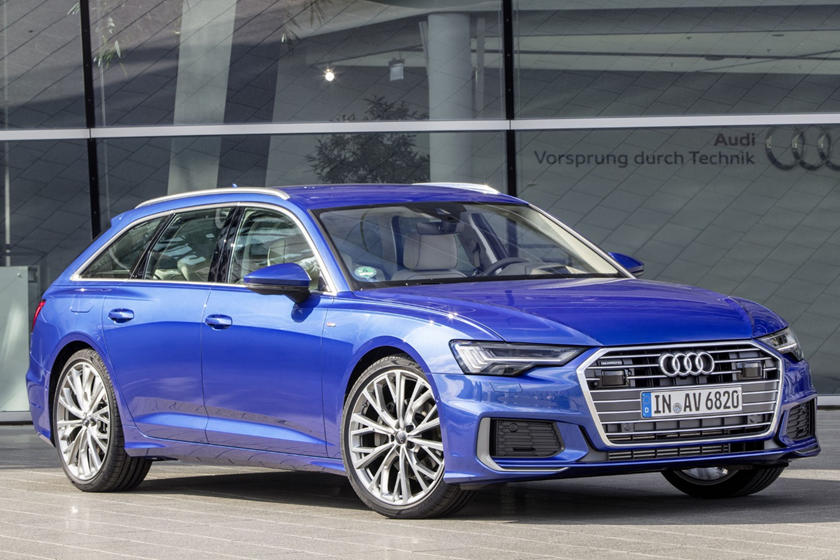
In fact, with as much as 59.3 cubic feet freed up when the rear seats are folded down, it has almost as much cargo capacity as the Q5. But at less than 58 inches tall, it's nowhere near as high as a crossover. That means a slippery shape with a low 0.27 drag coefficient. And it boasts more elbow room (front and rear) and rear-seat knee room than anything else in its class, which includes rivals like the BMW 5 Series Touring, Mercedes E-Class Estate, Jaguar XF Sportbrake, and Volvo V90.

From the C-pillar forward, it's essentially the same vehicle as the A6 sedan, right down to Audi's latest MMI infotainment system and 39 driver-assistance and safety systems. European customers will be able to choose between three turbodiesel engine options: a 2.0-liter inline-four with 204 hp (mated to an eight-speed automatic transmission) and a 3.0-liter V6 with either 231 hp or 286 hp (mated to a seven-speed dual-clutch gearbox with standard Quattro all-wheel drive). There'll be four suspension options and an assuredly long list of options. Just don't go asking for that list at your local Audi dealership here in the States.

Wednesday, 5 June 2019

2019 Audi A8 Starts At $83,800 In America

That makes it more expensive than a BMW 7 Series but much cheaper than a Mercedes S-Class.

Believe it or not, it’s been over a year since Audi unveiled the all-new A8 at an event in Barcelona. Since then, there hasn’t been a lot of news surrounding the automaker’s new flagship sedan other than the fact the American model won’t be getting Level 3 autonomy. At the time, pricing details for the 2019 A8 were revealed for Europe, but US pricing has been unknown – until now.

Audi recently updated the online configurator for the new A8, confirming that the luxury sedan will set you back $83,800 when it goes on sale later this year plus $995 taxes, bringing the total to $84,795. Compared to its closest rivals, the 2019 A8 is $150 more expensive than the BMW 7 Series, which starts at $84,645, but considerably cheaper than a Mercedes S-Class starting at $90,895. For the asking price, you’re getting a supremely luxurious sedan powered by a mild hybrid 3.0-liter V6 turbocharged engine producing 335 horsepower and 369 lb-ft of torque.

This enables the 2019 A8 to hit 0-62 mph in 5.6 seconds before reaching an electronically-limited top speed of 130 mph. As standard, the 2019 A8 includes adaptive air suspension for a sublimely smooth ride, a Bang & Olufsen sound system, full LED headlights, MMI Navigation with Virtual Cockpit, and 19-inch wheels. But if you can afford an Audi A8, you’ll want to explore the extensive range of options available in the configurator. There’s a choice of 10 exterior colors and two alloy wheel designs, or you can equip a $3,400 lighting package featuring LED Matrix headlights and OLED taillights.

Shelling out an extra $7,550 for the Executive Rear Seat Comfort package adds heated and powered rear seats, a full-length center console covered in leather, folding tables, footrests, and LED Matrix reading lights. There’s also a Smart Remote Control and a rear passenger side relaxation seat with a footrest and feet massager.

For the five-seat model, Audi is also offering a Rear Seat Comfort package for $3,500, which includes heated, ventilated and massaging seats as well as rear power lumbar support. The package also has the smart remote control and lets occupants adjust the front passenger seat from the rear of the car.

Other available packages include the $4,250 Luxury package that adds ambient interior lighting, Valcona leather upholstery and an Alcantara headliner, and the even swankier $4,150 Executive package, which adds dual-pane acoustic glass, a head-up display, a heated steering wheel and 22-way power front seats with heating, ventilation and massage functions. This package includes driver assists such as rear cross traffic alert and side assist with exit warning. A Driver Assistance package is also available with more tech including adaptive cruise assist, traffic jam assist, turn assist, predictive efficiency assist, intersection assist, active lane assist, and traffic sign recognition technology. All-wheel steering can be added for $1,950.

Currently, the online configurator only lets you spec the V6 model, but it will eventually be updated to include the more powerful V8 version, which features a twin-turbo 4.0-liter that produces 460 hp and 486 lb-ft.

Monday, 6 May 2019

Audi e-tron New Reveal Date Ditches Europe For America

Audi will be showing its first ever fully electric model a few weeks after Mercedes debuts the ECQ.

Audi’s first ever all-electric model, the e-tron SUV, was originally going to be unveiled in just a few weeks at an event in Brussels on August 30. However, those plans were scrapped after Audi’s CEO Rupert Stadler was arrested following allegations he was tampering with evidence during the Volkswagen Dieselgate investigation. Consequently, the e-tron's much-anticipated debut was delayed, but we now know the new reveal date.

Audi has announced the e-tron will debut on September 17 at an event in San Francisco. Unfortunately, that means Audi's Jaguar I-Pace fighter will be revealed a few weeks after its chief rival Mercedes-Benz shows the ECQ to the world on September 4 in Stockholm, Sweden. Full specifications for the e-tron will be detailed on Audi’s US website on the day of the event, including pricing, allowing customers to configure their e-tron. From September 17, customers will be able to reserve the e-tron with a refundable $1,000 reservation fee. After customers place a reservation, they will be able to track it online with their local dealer. More details about this system will be revealed at the San Francisco event.

“We’re introducing a premium, customer-centric vehicle in a premium, customer-centric way,” said Scott Keogh, president of Audi of America. “With our owners and our dealers, this process allows us to offer transparency from reservation and build all the way through delivery.”

As well as announcing the debut date and reservation details, Audi also released a new teaser image of the electric crossover’s silhouette covered under a sheet. It isn’t very revealing, but from the pre-production prototype shown at the Geneva Motor Show we know it will have a singleframe grille, small air intakes and slender headlights.

Audi has also previously confirmed the crossover will have a drag coefficient of 0.28. it will also be the first production model available with futuristic “virtual exterior mirrors,” which act as camera mirrors broadcasting footage to OLED displays mounted on the door panels. As for powertrain details, Audi says the e-tron will be powered by two electric motors and a 95 kWh battery pack providing a range of 248 miles on a single charge.

Customer deliveries for the e-tron are expected to start in early 2019. It will be the first of three fully electric vehicles Audi will debut by 2020, with nearly 30 percent of its customers in the US anticipated to go electric by 2025.

Saturday, 27 April 2019

Audi e-tron New Reveal Date Ditches Europe For America

Audi will be showing its first ever fully electric model a few weeks after Mercedes debuts the ECQ.

Audi’s first ever all-electric model, the e-tron SUV, was originally going to be unveiled in just a few weeks at an event in Brussels on August 30. However, those plans were scrapped after Audi’s CEO Rupert Stadler was arrested following allegations he was tampering with evidence during the Volkswagen Dieselgate investigation. Consequently, the e-tron's much-anticipated debut was delayed, but we now know the new reveal date.

Audi has announced the e-tron will debut on September 17 at an event in San Francisco. Unfortunately, that means Audi's Jaguar I-Pace fighter will be revealed a few weeks after its chief rival Mercedes-Benz shows the ECQ to the world on September 4 in Stockholm, Sweden. Full specifications for the e-tron will be detailed on Audi’s US website on the day of the event, including pricing, allowing customers to configure their e-tron. From September 17, customers will be able to reserve the e-tron with a refundable $1,000 reservation fee. After customers place a reservation, they will be able to track it online with their local dealer. More details about this system will be revealed at the San Francisco event.

“We’re introducing a premium, customer-centric vehicle in a premium, customer-centric way,” said Scott Keogh, president of Audi of America. “With our owners and our dealers, this process allows us to offer transparency from reservation and build all the way through delivery.”

As well as announcing the debut date and reservation details, Audi also released a new teaser image of the electric crossover’s silhouette covered under a sheet. It isn’t very revealing, but from the pre-production prototype shown at the Geneva Motor Show we know it will have a singleframe grille, small air intakes and slender headlights.

Audi has also previously confirmed the crossover will have a drag coefficient of 0.28. it will also be the first production model available with futuristic “virtual exterior mirrors,” which act as camera mirrors broadcasting footage to OLED displays mounted on the door panels. As for powertrain details, Audi says the e-tron will be powered by two electric motors and a 95 kWh battery pack providing a range of 248 miles on a single charge.

Customer deliveries for the e-tron are expected to start in early 2019. It will be the first of three fully electric vehicles Audi will debut by 2020, with nearly 30 percent of its customers in the US anticipated to go electric by 2025.

Wednesday, 17 April 2019

2019 Audi Q8 Starts At $67,400 In America

That makes Audi’s new flagship SUV around $2,000 more expensive than the range-topping Q7.

Back in June, Audi unveiled its new flagship SUV, the Q8, but details about the US model have been kept under wraps – until now. Due to go on sale later this year, the 2019 Audi Q8 will start at $67,400 plus a $995 destination and delivery charge. That makes it around $2,000 more expensive than the range-topping Q7. For the base model, the Q8 comes equipped with LED headlights, adaptive dampers, three-zone automatic climate control, a panoramic sunroof and leather seats as standard.

Inside, the Q8 features an MMI infotainment system comprising of a 10.1-inch upper display for the infotainment and an 8.6-inch lower display for the climate and other functions, as well as a 12.3-inch digital instrument cluster. Apple CarPlay, and Android Auto is also included.

Moving up the range, the Premium Plus trim will set you back $71,400 plus delivery and destination and includes blind-spot warning, wireless phone charging, rear collision and cross traffic sensing, and a Bang & Olufsen sound system. For $76,550, the Premium Plus trim adds a color head-up display and a 19-speaker Bang & Olufsen 3D Advanced Sound System that “delivers nearly true-to-life surround sound.”

The higher trims also include a wider choice of optional driver assists, including a hands-on semi-autonomous adaptive cruise control system, a surround-view camera, traffic sign recognition, and a blind spot monitor.

Every trim comes with the same powertrain. The Audi Q8 is arriving in America with a turbocharged 3.0-liter turbocharged V6 that sends 335 hp and 369 lb-ft of torque to all four wheels through an eight-speed automatic transmission. 0-62 mph takes 5.6 seconds. The new V6 engine features a twin-scroll turbocharger positioned directly inside the “V” and a revised valvelift system to improve the engine responsiveness and performance. All Q8s are also equipped with a 48-volt mild hybrid system.

Wednesday, 20 March 2019

Is This The End Of European-Built Luxury Convertibles In America?

One word: tariffs.

There’s a certain irony to what you’re about to read. Before he was President of the United States, Donald Trump owned European luxury cars. Now that he’s the man in charge, he wants to slap a 20 percent tariff on vehicles imported from and assembled in the EU. Nothing is final just yet, but if those tariffs are imposed, certain niche vehicles simply won’t survive, Reuters reports. “The tariffs, if they materialize, would call into question the business case for many niche models we currently sell in the United States,” said a senior executive at one carmaker.

“Convertibles are a particular headache. With Brexit and US tariffs, this market could shrink further.” One potential way to save convertibles is for automakers to forge alliances to share production costs, exactly what BMW and Toyota did for the upcoming new Z4 and reborn Supra. Unfortunately, China is of no help if US-imposed tariffs happen. High pollution and a scorching hot sun are the worst conditions for convertibles, hence the reason nobody in Asia buys them. Europe, especially once Brexit goes into full effect and even more tariffs are created, can’t sustain the luxury convertible market on its own.

But why not simply have those German automakers, specifically BMW, Mercedes-Benz, Volkswagen, begin building convertibles in the US where all three already have major production facilities? The problem with those facilities is that they were designed from the get-go to mass produce high-volume vehicles, such as the Volkswagen Passat. Retooling them to include low-volume convertible production makes no sense, financially and practically speaking. If Trump gets his way with those tariffs, convertibles like the Audi S5 Cabrio, BMW 4 Series Convertible, and Mercedes-Benz SL Roadster will almost immediately become poor business cases, and that will be that.

Friday, 15 February 2019

Is This The End Of European-Built Luxury Convertibles In America?

One word: tariffs.

There’s a certain irony to what you’re about to read. Before he was President of the United States, Donald Trump owned European luxury cars. Now that he’s the man in charge, he wants to slap a 20 percent tariff on vehicles imported from and assembled in the EU. Nothing is final just yet, but if those tariffs are imposed, certain niche vehicles simply won’t survive, Reuters reports. “The tariffs, if they materialize, would call into question the business case for many niche models we currently sell in the United States,” said a senior executive at one carmaker.

“Convertibles are a particular headache. With Brexit and US tariffs, this market could shrink further.” One potential way to save convertibles is for automakers to forge alliances to share production costs, exactly what BMW and Toyota did for the upcoming new Z4 and reborn Supra. Unfortunately, China is of no help if US-imposed tariffs happen. High pollution and a scorching hot sun are the worst conditions for convertibles, hence the reason nobody in Asia buys them. Europe, especially once Brexit goes into full effect and even more tariffs are created, can’t sustain the luxury convertible market on its own.

But why not simply have those German automakers, specifically BMW, Mercedes-Benz, Volkswagen, begin building convertibles in the US where all three already have major production facilities? The problem with those facilities is that they were designed from the get-go to mass produce high-volume vehicles, such as the Volkswagen Passat. Retooling them to include low-volume convertible production makes no sense, financially and practically speaking. If Trump gets his way with those tariffs, convertibles like the Audi S5 Cabrio, BMW 4 Series Convertible, and Mercedes-Benz SL Roadster will almost immediately become poor business cases, and that will be that.