Showing posts with label German. Show all posts

Thursday, 8 August 2019

VW Group's EX-Engineering Chief Wants Out Of A German Prison

After 8 months in the slammer, he's really sorry for Dieselgate.

Very few of those involved with the Volkswagen Dieselgate scandal have gone to prison, but former VW Group executive Wolfgang Hatz is one of them. For the past eight months, Hatz has been incarcerated in Germany over his alleged involvement in the emissions scandal. According to Automotive News Europe, he’s now appealing to Germany’s highest court in order secure his freedom. He has not been convicted of a crime. Hatz was VW Group’s powertrain chief from 2011 until the scandal broke in 2015.

Before that he served as Audi’s head engine developer from 2001 to 2007. He also spent time at Porsche as R&D boss. Prior to joining the VW Group in 2001, Hatz worked for BMW and Opel. But it was under his watch when the defeat devices were developed and incorporated into the diesel engines, such as the 3.0-liter V6 diesel used by Audi. Audi admitted in late 2015 that this specific engine had the device. Hatz’s lawyers are trying to get him out of prison by offering to surrender his passport and a bail post worth millions of Euros. Munich-based prosecutors have declined the request, hence the appeal to the top court.

What also doesn’t bode well for Hatz is that he was a close associate and friend of former VW CEO Martin Winterkorn, who was recently charged in the US with conspiracy and fraud regarding Dieselgate. The US is currently trying to have him extradited from Germany. The German constitution, however, is preventing that from happening. As for Hatz, he’s still stuck in the slammer until the court says otherwise.

Tuesday, 18 June 2019

Three German Super Coupes Show Us Why The 0-130 MPH Test Is Better

The 0-60 mph test is outdated. We need a new standard to reflect today’s level of performance.

The thing about 0-60 mph times is that they’re flawed. Sure, there are hardly more exhilarating ways to us a patch of empty road than to open the floodgates of a car, almost any car, and seeing what its engine, drivetrain, chassis, and tires can do at full tilt. That still doesn’t take away from the fact that 0-60 mph times are flawed. To put it simply, most automakers can design a car that pulls hard up to the minute-per-mile mark if they want, so why not raise the bar? Heck, a Chrysler Pacifica can do it better than Toyota's sports coupe but which would you pick?

All you need is an ample amount of power, all-wheel drive, traction control, and plenty of grip on the tires to better your odds. The Jeep Grand Cherokee Trackhawk makes 60 mph happen in 3.5 seconds, coincidentally matching the winner of this German sports car drag race. The real challenge, though, is what happens beyond 60 mph.

That’s around the time that engines begin to lose their breath and gearing becomes tailored for efficiency rather than acceleration. To see which of these three German cars, a BMW M2, Audi TT RS and Porsche 718 Cayman S, is better than the others, it becomes important to test them on a straight runway long enough to hit 130 mph and brake to a halt afterwards. We won’t spoil the winner here, but it’s worth mentioning that all of the aforementioned methods of getting to 60 mph the fastest work favorably as long as the engine is powerful enough.

Saturday, 16 February 2019

Why Do German Luxury Cars Rapidly Decrease In Value?

If you're prepared to spend a small fortune, better start with a big one.

So you’re in the market for a new Audi, BMW, Porsche, or Mercedes-Benz. Congratulations. Because you’ve made it to a successful stage in your career and worked hard, isn’t it about time to reward yourself with something from those masterful engineers in Munich or Stuttgart? Of course, but you need to understand something before any purchase is made: Luxury cars, especially German ones, dramatically depreciate in value faster than you can learn to pronounce Umweltverschmutzung (translation: pollution).

There are several reasons why, and by the time you’re done reading this you may think opting for a used German luxury vehicle is the better option. Why not let some other sucker pay the depreciation, right? Not necessarily. First things first, you should know that, according to vehicle pricing website iSeeCars.com, the average vehicle loses 34.5 percent of its value the moment it leaves the dealership. And no, a vehicle’s reliability does not necessarily directly correlate with its re-sale value. Of course poor reliability ratings won’t help, but sometimes neither do good ratings. Leasing can contribute towards a drop in re-sale value, too.

In that same iSeeCars.com analysis from last summer, it was discovered that certified pre-owned luxury brands tend to lose more value than their downmarket competitors. Those vehicles were previously leased and turned in after three years. Considering leases account for more than 50 percent of BMW and Mercedes-Benz sales, there’s been a constant stream of three-year-old vehicles hitting the used car market, which in turn drives down costs. That’s good for those shopping for used cars, but not so much for people who opt to buy with the hope of getting a good trade-in price in the future. But these are market forces us mere mortals have no direct control over.

Point being is not to let used car prices coming off leases determine whether or not you buy that shiny new BMW 5 Series you’ve had your eye on. There are other things to consider, such as ownership costs. Anyone who’s ever owned a German luxury car can probably tell you stories about trips to the dealership that ended up costing a small fortune. Sometimes the vehicle’s warranty covers all or part of the costs. Sometimes it doesn’t. It all depends on what’s specifically not working. Why can this be so pricey? Because German luxury brands have their own in-house trained technicians. For example, want to be an Audi dealership technician? Fine, you must graduate from “Audi School” first.

These services cost more because tecnicians cost more to train for vehicles that are more complicated than your typical Chevrolet. Examples of this can be anything from a new engine component to a rearview mirror. These parts, often times, must be special ordered from Germany. Those costs are then passed down to owners who have no choice but to pay up or their vehicle will depreciate even more than it already has. Owners also, understandably, want that replacement rearview mirror or alternator. Go figure. At this point we want to clarify something: German luxury vehicles are excellent overall. In our experiences we’ve often times found their technologies, mainly the engines, to be far ahead of foreign competitors.

Let’s face it, the Germans are amazing engineers. They love to tinker and re-examine every nut and bolt. There’s always something that can be made better and they’re determined to do so. But sometimes this approach can go a bit too far. That’s called over engineering. As impressive as the final product may be, it becomes increasingly complicated to maintain and repair, hence the specially trained technicians. This is not to say Japanese luxury vehicles, for example, are less impressive engineering wise, but the Asian approach does differ at times from that of their German counterparts.

The Germans are absolutely wonderful at designing advanced vehicles, but they don’t always build them like the Japanese typically do. The Japanese long ago took pride in production quality and still do. Two countries with two different approaches. We also must commend German luxury vehicles for often being the first to introduce new technologies. Remember back in 2002 when BMW introduced something called “iDrive” in its fourth generation 7 Series? No one, and we mean no one, could figure how the hell that damn knob and screen worked. Sure, one of BMW’s systems engineers could easily explain it, but only a fellow engineer would actually get it. Over time, iDrive has been fine-tuned and it’s now (mostly) understandable.

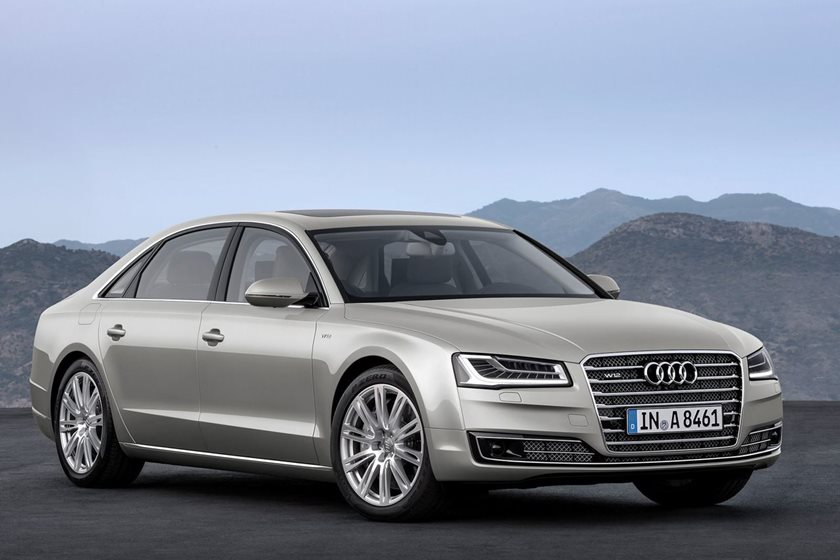
The rest of the industry, not only BMW competitors, quickly developed similar systems of their own. Today, a $20,000 Mazda3 also has an infotainment system. Of course the reasons for German luxury vehicle depreciation mentioned above are only a few out of many, but now it’s time to list a few specific examples. First up is the 2015 Audi A8. We found a used A8 L 4.0 T in solid overall condition selling for $43,800. Original MSRP: $77,400. How about a 2015 BMW X5 xDrive35i for $33,446. Original MSRP: $56,200, and that’s without any optional packages. But let’s go back in time even further. A 2004 Maybach 57 cost over $305,000 brand new. All yours today for as little as $45,000, as found on TrueCar.

And don’t forget this very simple logic: any vehicle with an originally high MSRP will always be expensive to maintain, no matter its age. Of course there have been cases when decades-old German cars suddenly begin to dramatically increase in value. Examples include the BMW E30 M3 and, more recently, classic bodied Porsche 911s. Unfortunately no one can predict whether values like these will appreciate over time or not. Don’t hold your breath. So where does this leave you as you stare down that gorgeous new BMW 5 Series the salesman is anxious to cut you a good price on? Should you go for it? Is buying better than leasing, or vice versa?

Remember, once the lease ends you’re stuck with nothing. The decision is ultimately up to you and the strength of your bank balance. But here’s a generally good rule of thumb: if you want to spend a small fortune on any vehicle, then you’d better start with a big one.

German Automakers Bend To Trump's Will By Offering To Drop Tariffs

Those "very bad" German automakers want to make a deal.

It was an outcome Germany’s automakers could not accept for obvious financial reasons: losing out on the highly profitable US market because of a newly imposed import tax. In light of President Trump’s announcement to impose tariffs on European Union-made products, including vehicles, automakers Volkswagen, BMW and Mercedes-Benz have said they’d be willing to drop all tariffs with the US, according to Automotive News Europe and The Wall Street Journal.

Sources with inside knowledge of the situation claim “German automakers will support the EU’s 10 percent tax on auto imports from the US and a 2.5 percent duty on auto imports going away if Trump backs off” the 25 percent border tax threat on imports from Europe. America’s ambassador to Germany, Richard Grenell, has already met with executives from the German automakers and he’s not taking their proposal directly to administration officials. Another area of concern for these automakers are their US-based production plants and the thousands of people they employ. Trump has already ordered a 25 percent tariff on imported steel and a 10 percent tariff on imported aluminum.

The EU has responded in kind with a 25 percent import duty on a variety of products beginning this week. The German automakers very clearly do not want to be hurt by this trade war, hence their willingness to make such concessions. After all, new Audis, BMWs, and Mercedes are already expensive enough; adding a huge tax to the final price tag will scare away too many buyers.

Thursday, 17 January 2019

Audi S6 Avant Spied Looking Like Forbidden German Fruit

At least the US will probably get the sedan.

Audi has already shown off the 2019 A6 Sedan and Avant, which are both powered by a 3.0-liter turbocharged V6 producing 340 horsepower. A more powerful S6 is on the way, which will bridge the gap between the base A6, and the more hardcore RS6. We've spotted the S6 Sedan testing, but now we've had the chance to see the S6 Avant running laps on the Nurburgring in Germany. The Avant will likely be mechanically identical to the Sedan, but will obviously offer greater practicality and an added cool factor with its wagon body style.

The US has always had a bad track record with receiving Audi RS cars, especially wagons. The next generation RS6 could be a surprise import to the US, but we doubt that the lesser S6 Avant would also be brought over. The S6 is expected to utilize a smaller 2.9-liter V6 with two turbochargers. Audi uses this same engine in the RS5, where it produces 444 hp. This engine is also found in the Porsche Panamera 4S, where it delivers 440 hp. The current S6 uses a 4.0-liter twin-turbo V8, which pumps out 450 hp. We expect that Audi will at least match the old car's output, and possibly outdo the BMW M550i's 456 hp figure.

The new S6 should be an incredibly quick car, but we doubt the twin-turbo V6 will sound as good as the 4.0-liter V8. We can also hope and pray that the US receives either the S6 or RS6 Avant, though we know not to get our hopes up.