The all-new Audi A8 has become the complete luxury sedan.
Of the three traditional German prestige marques that battle each other from compact car to super sports car level, Audi was the latecomer to the luxury sedan party. Mercedes started this flagship game back in the 1930s, and BMW’s first 7-Series made its debut in 1977. Audi did not have a reply until 1988, when they launched the V8, the first production luxury sedan with a 4WD option. But it was not until the V8’s successor arrived in 1994 that a big Audi proudly wore the A8 badge.
![]()
![]() Audi’s all new fifth generation flagship, internally
known as the D5, is the fourth car to bear the A8 moniker. Based on Audi’s MLB
Evo floorpan, shared with the Audi Q7 and the latest Porsche Cayenne, the latest A8/L is
slightly narrower than the outgoing model but a tad longer. The first A8 (D2) of
1994 had a good, solid, Teutonic look to it and still has reasonable presence
today. This also applies to the D3 that succeeded it, and was also the first A8
to receive Audi’s deeper and bolder front grille look at its mid-life facelift
time. However, the A8 (D4) of 2010 was less convincing as a design. It was
rather bland, not a plus point in a segment where presence and authority exuded
by the likes of the Mercedes S-Class is paramount.
Audi’s all new fifth generation flagship, internally
known as the D5, is the fourth car to bear the A8 moniker. Based on Audi’s MLB
Evo floorpan, shared with the Audi Q7 and the latest Porsche Cayenne, the latest A8/L is
slightly narrower than the outgoing model but a tad longer. The first A8 (D2) of
1994 had a good, solid, Teutonic look to it and still has reasonable presence
today. This also applies to the D3 that succeeded it, and was also the first A8
to receive Audi’s deeper and bolder front grille look at its mid-life facelift
time. However, the A8 (D4) of 2010 was less convincing as a design. It was
rather bland, not a plus point in a segment where presence and authority exuded
by the likes of the Mercedes S-Class is paramount.
![]()
![]() It was thus no surprise that the 2014 facelift was quite comprehensive and
included new body panels that gave the car a tauter, more purposeful look.
Learning from that expensive lesson, Audi’s designers put more muscle into the
new A8’s looks from day one. Subtle haunches over its front and rear arches
deliver a greater sense of latent power under the skin than before. Like a
well-groomed bodybuilder in a pin-stripe suit, the new A8/L looks calm with its
latent power, and is arguably less overt than the recently facelifted S-Class. Under its aluminium
skin it features five suspension links at each corner, with air springs as
standard and active damping as an option.
It was thus no surprise that the 2014 facelift was quite comprehensive and
included new body panels that gave the car a tauter, more purposeful look.
Learning from that expensive lesson, Audi’s designers put more muscle into the
new A8’s looks from day one. Subtle haunches over its front and rear arches
deliver a greater sense of latent power under the skin than before. Like a
well-groomed bodybuilder in a pin-stripe suit, the new A8/L looks calm with its
latent power, and is arguably less overt than the recently facelifted S-Class. Under its aluminium
skin it features five suspension links at each corner, with air springs as
standard and active damping as an option.
![]()
![]() The quattro 4WD system is also standard, and thankfully there is no
entry-level front-wheel-drive variant this time round. From the driver's seat
the new car is supremely comfortable, and I felt I was sitting in and not on the
car. Bearing in mind that people over 50, who will make up the bulk of A8/L
buyers, are not necessarily computer or tech savvy, it is important that the
plethora of driver aids and infotainment gadgets appearing in these new cars be
easily accessible and logical to users. In that respect Audi has always been a
leader in intuitive control interfaces. Not long after BMW Introduced their
iDrive system in the E65 7-Series, with its drop down menu driven interface,
Audi launched its first MMI system.
The quattro 4WD system is also standard, and thankfully there is no
entry-level front-wheel-drive variant this time round. From the driver's seat
the new car is supremely comfortable, and I felt I was sitting in and not on the
car. Bearing in mind that people over 50, who will make up the bulk of A8/L
buyers, are not necessarily computer or tech savvy, it is important that the
plethora of driver aids and infotainment gadgets appearing in these new cars be
easily accessible and logical to users. In that respect Audi has always been a
leader in intuitive control interfaces. Not long after BMW Introduced their
iDrive system in the E65 7-Series, with its drop down menu driven interface,
Audi launched its first MMI system.
![]()
![]() I commented at the time that it felt like BMW’s iDrive had a rather opaque
Microsoft Windows style drop down menu interface, while a Mac user had designed
Audi’s MMI. MMI has only got better over the years and Audi’s Virtual Cockpit
debuted on the TT in late 2014, and has now been rolled out across the range.
With more dashboard real estate on offer, the new A8 enabled the engineers to
take this and the infotainment system to the next level. The latest processors
behind the infotainment system are 50 times faster and feature two large
touchscreen displays - a 1540 x 720 pixel, 10.1 inch on the dashboard, and a
1280 x 660, 8.6-inch center console screen.
I commented at the time that it felt like BMW’s iDrive had a rather opaque
Microsoft Windows style drop down menu interface, while a Mac user had designed
Audi’s MMI. MMI has only got better over the years and Audi’s Virtual Cockpit
debuted on the TT in late 2014, and has now been rolled out across the range.
With more dashboard real estate on offer, the new A8 enabled the engineers to
take this and the infotainment system to the next level. The latest processors
behind the infotainment system are 50 times faster and feature two large
touchscreen displays - a 1540 x 720 pixel, 10.1 inch on the dashboard, and a
1280 x 660, 8.6-inch center console screen.
![]()
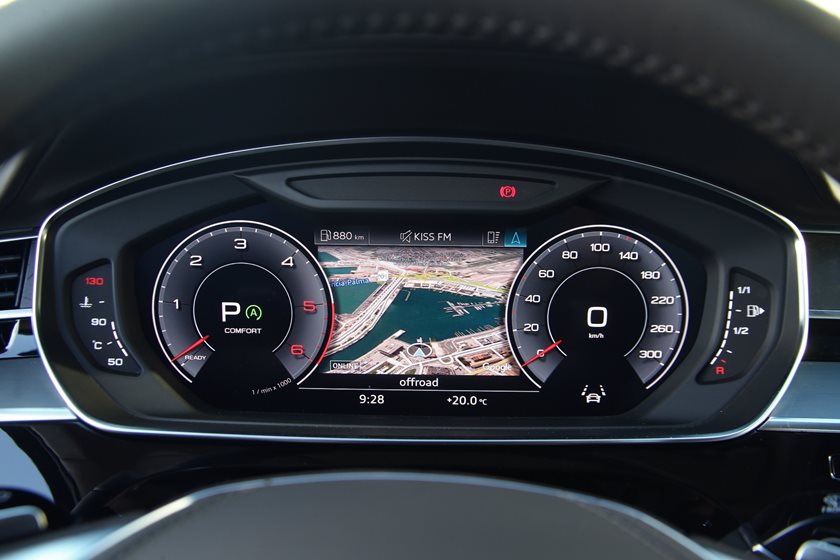
![]() The bigger screen looks after telematics, while the smaller one controls the
HVAC system and some convenience features.The instrument pack technology will be
familiar to anyone who has driven one of the current Audi A4, TT or R8 models.
This all works quite intuitively and I found no issues in navigating the various
functions using the big touchscreen, which has amazing clarity. I also like the
fact that that big screen is integrated into a black piano lacquer trim that
spans the whole dashboard. This means that the screen does not leave a big black
‘hole’ in the dashboard when it is off as is the case with other cars, unless the screen retracts or rolls away. As an
alternative to the latter system, this elegant solution saves cost, weight and
complexity.
The bigger screen looks after telematics, while the smaller one controls the
HVAC system and some convenience features.The instrument pack technology will be
familiar to anyone who has driven one of the current Audi A4, TT or R8 models.
This all works quite intuitively and I found no issues in navigating the various
functions using the big touchscreen, which has amazing clarity. I also like the
fact that that big screen is integrated into a black piano lacquer trim that
spans the whole dashboard. This means that the screen does not leave a big black
‘hole’ in the dashboard when it is off as is the case with other cars, unless the screen retracts or rolls away. As an
alternative to the latter system, this elegant solution saves cost, weight and
complexity.
![]()
![]() Cabin room is generous in both compartments, particularly so in the rear of
the 120mm (5.1 inch) longer LWB version, where the extra legroom allows you to
specify individual rear seats with a centre console in between. As with its
rivals from BMW and Mercedes, the L variant comes with the option of a reclining
relaxation rear seat opposite the driver, and a footrest that motors out from
the back of the forward adjusted front passenger seat. With the seat thus
extended and an Audi driver behind the wheel I felt on top of the world, and
closed my eyes to concentrate on what is most relevant to a limousine - silence
and ride comfort.
Cabin room is generous in both compartments, particularly so in the rear of
the 120mm (5.1 inch) longer LWB version, where the extra legroom allows you to
specify individual rear seats with a centre console in between. As with its
rivals from BMW and Mercedes, the L variant comes with the option of a reclining
relaxation rear seat opposite the driver, and a footrest that motors out from
the back of the forward adjusted front passenger seat. With the seat thus
extended and an Audi driver behind the wheel I felt on top of the world, and
closed my eyes to concentrate on what is most relevant to a limousine - silence
and ride comfort.
![]()
![]() While the new A8 is quiet, further extraneous noise is kept from the cabin by
the two optional glass packages. The first is acoustic double-glazing, while the
second adds extra UV protection to the double-glazing to keep the cabin cooler
in hot climates. In rear seat ride comfort terms the previous A8L was good, and
I put it on the same level as its BMW 7 Series rival at the time. However, both
these cars gave best to the W221 and W222 S-Class models, which may not be as
good a mount for the keen driver, but are measurably superior in rear seat ride
comfort.
While the new A8 is quiet, further extraneous noise is kept from the cabin by
the two optional glass packages. The first is acoustic double-glazing, while the
second adds extra UV protection to the double-glazing to keep the cabin cooler
in hot climates. In rear seat ride comfort terms the previous A8L was good, and
I put it on the same level as its BMW 7 Series rival at the time. However, both
these cars gave best to the W221 and W222 S-Class models, which may not be as
good a mount for the keen driver, but are measurably superior in rear seat ride
comfort.
![]()
![]() Latterly, the current BMW 7 Series with its all-new air
suspension came close to the Mercedes, and pips the A8/L D4 to the post as VIP
limo transport, but the latest A8/L with its new generation active air
suspension turns the tables on the very competent BMW, and takes the fight to
Stuttgart. The low speed secondary ride of the new A8L is sublime, and while you
can feel the kind of small bumps that were discernible in the outgoing model,
they are now rounded off and absorbed to the point where you simply celebrate
Audi’s mastery of the physics involved. The sheer speed with which the computer
controlled damping works results in a seamless experience at high speed is
similarly impressive.
Latterly, the current BMW 7 Series with its all-new air
suspension came close to the Mercedes, and pips the A8/L D4 to the post as VIP
limo transport, but the latest A8/L with its new generation active air
suspension turns the tables on the very competent BMW, and takes the fight to
Stuttgart. The low speed secondary ride of the new A8L is sublime, and while you
can feel the kind of small bumps that were discernible in the outgoing model,
they are now rounded off and absorbed to the point where you simply celebrate
Audi’s mastery of the physics involved. The sheer speed with which the computer
controlled damping works results in a seamless experience at high speed is
similarly impressive.
![]()
![]() Coupled with the dynamic all wheel steering this car's high-speed stability
is unerring, which makes for stress free motorway driving. The measured
reduction in turning circle thanks to the rear wheel steering is 1.1 meters,
allowing an A8L to match the 11.4 meters turning circle of the much smaller A4.
At speeds over 37 mph, the rear wheels can turn up to 1.5 degrees to effectively
‘lengthen’ the cars wheelbase, resulting in greater dynamic stability. With
Sport mode engaged, and using the paddle shifters to control the standard
eight-speed Tiptronic used on all variants, the A8 gobbled up the cross country
route, the low roll, exquisite body control and 4WD traction making for rapid,
drama-free progress even at a fair clip.
Coupled with the dynamic all wheel steering this car's high-speed stability
is unerring, which makes for stress free motorway driving. The measured
reduction in turning circle thanks to the rear wheel steering is 1.1 meters,
allowing an A8L to match the 11.4 meters turning circle of the much smaller A4.
At speeds over 37 mph, the rear wheels can turn up to 1.5 degrees to effectively
‘lengthen’ the cars wheelbase, resulting in greater dynamic stability. With
Sport mode engaged, and using the paddle shifters to control the standard
eight-speed Tiptronic used on all variants, the A8 gobbled up the cross country
route, the low roll, exquisite body control and 4WD traction making for rapid,
drama-free progress even at a fair clip.
![]()
![]() The alloy wheel range encompasses 17-inch to 21-inch, and the LWB test cars
at the launch wore 265/40R20-inch Goodyear Eagle F1 rubber, with the entry-level
SWB 50 TDI cars on 255/45R19-inch Michelins. In practice, the suspension is so
well calibrated for all these factory wheel and tire options that the 19s on the
SWB car were barely more comfortable from behind the wheel. Of course while the
smaller 17- and 18-inch sizes might make a bigger difference, they certainly
would not look good on such a large car.
The alloy wheel range encompasses 17-inch to 21-inch, and the LWB test cars
at the launch wore 265/40R20-inch Goodyear Eagle F1 rubber, with the entry-level
SWB 50 TDI cars on 255/45R19-inch Michelins. In practice, the suspension is so
well calibrated for all these factory wheel and tire options that the 19s on the
SWB car were barely more comfortable from behind the wheel. Of course while the
smaller 17- and 18-inch sizes might make a bigger difference, they certainly
would not look good on such a large car.
![]()
![]() For owners in markets such as the US where unleaded gas is the tipple of
choice, the turbocharged V6 55 TFSI quattro with 340 hp and 369 lb-ft of torque,
or the V8 60 TFSI quattro with cylinder-on-demand (COD) technology and 460 hp
and 487 lb-ft, are an extremely comfortable way to cover the miles. I drove the
latter whose engine is refined, potent, and provides good low-end grunt and
strong top-end thrust. Combined with the new chassis, this makes the new A8/L an
incrementally superior car to its forbearers in all respects, including comfort,
performance, fuel economy and emissions.
For owners in markets such as the US where unleaded gas is the tipple of
choice, the turbocharged V6 55 TFSI quattro with 340 hp and 369 lb-ft of torque,
or the V8 60 TFSI quattro with cylinder-on-demand (COD) technology and 460 hp
and 487 lb-ft, are an extremely comfortable way to cover the miles. I drove the
latter whose engine is refined, potent, and provides good low-end grunt and
strong top-end thrust. Combined with the new chassis, this makes the new A8/L an
incrementally superior car to its forbearers in all respects, including comfort,
performance, fuel economy and emissions.
![]()
![]() The W12 flagship, with its supercar challenging 585 hp and 590 lb-ft of
torque, is the only version that does not wear a number badge, just ‘W12’. We
were only able to drive it at modest speeds in a closed off test area, but as
expected its motor is eerily refined. The Audi A8/L production line is housed in
a new building in Neckarsulm, and the 50, 55 and 60 A8/L models go on sale in
Europe immediately, with US deliveries of LWB-only gas models starting in the
second half of 2018. Output will be ramped up over the coming months according
to demand, with up to 260 cars a day possible by late 2018.
The W12 flagship, with its supercar challenging 585 hp and 590 lb-ft of
torque, is the only version that does not wear a number badge, just ‘W12’. We
were only able to drive it at modest speeds in a closed off test area, but as
expected its motor is eerily refined. The Audi A8/L production line is housed in
a new building in Neckarsulm, and the 50, 55 and 60 A8/L models go on sale in
Europe immediately, with US deliveries of LWB-only gas models starting in the
second half of 2018. Output will be ramped up over the coming months according
to demand, with up to 260 cars a day possible by late 2018.
The W12 and V8 TDI models will follow during 2018, along with the A8L 60 e-tron quattro, which will be able to drive about 30 miles on battery power and be charged inductively from a garage or carport floor mounted unit. With quattro 4WD and air suspension as standard, the new Audi A8/L stands as the most complete car in its class out of the box. And with a rear seat experience that now matches the much-vaunted and recently face-lifted Mercedes S-Class for secondary ride, Audi finally has a convincing all-round contender in the luxury sedan class.
Of the three traditional German prestige marques that battle each other from compact car to super sports car level, Audi was the latecomer to the luxury sedan party. Mercedes started this flagship game back in the 1930s, and BMW’s first 7-Series made its debut in 1977. Audi did not have a reply until 1988, when they launched the V8, the first production luxury sedan with a 4WD option. But it was not until the V8’s successor arrived in 1994 that a big Audi proudly wore the A8 badge.
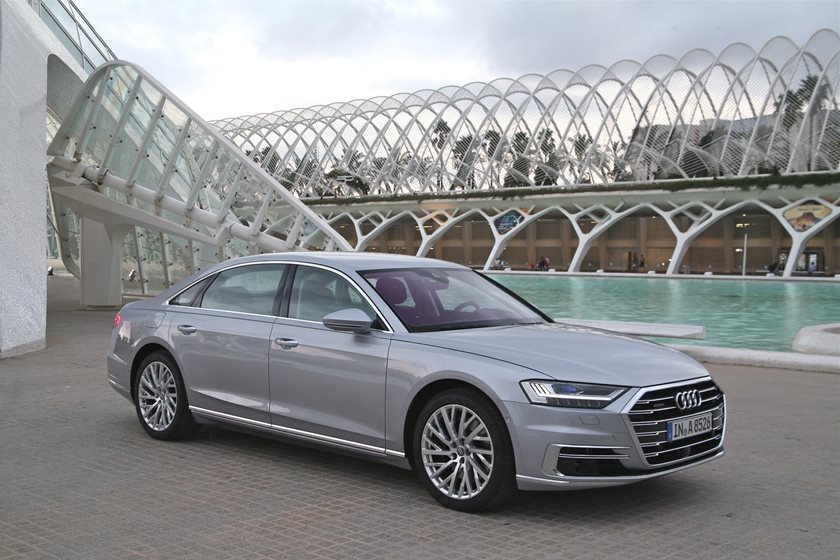
 Audi’s all new fifth generation flagship, internally
known as the D5, is the fourth car to bear the A8 moniker. Based on Audi’s MLB
Evo floorpan, shared with the Audi Q7 and the latest Porsche Cayenne, the latest A8/L is
slightly narrower than the outgoing model but a tad longer. The first A8 (D2) of
1994 had a good, solid, Teutonic look to it and still has reasonable presence
today. This also applies to the D3 that succeeded it, and was also the first A8
to receive Audi’s deeper and bolder front grille look at its mid-life facelift
time. However, the A8 (D4) of 2010 was less convincing as a design. It was
rather bland, not a plus point in a segment where presence and authority exuded
by the likes of the Mercedes S-Class is paramount.
Audi’s all new fifth generation flagship, internally
known as the D5, is the fourth car to bear the A8 moniker. Based on Audi’s MLB
Evo floorpan, shared with the Audi Q7 and the latest Porsche Cayenne, the latest A8/L is
slightly narrower than the outgoing model but a tad longer. The first A8 (D2) of
1994 had a good, solid, Teutonic look to it and still has reasonable presence
today. This also applies to the D3 that succeeded it, and was also the first A8
to receive Audi’s deeper and bolder front grille look at its mid-life facelift
time. However, the A8 (D4) of 2010 was less convincing as a design. It was
rather bland, not a plus point in a segment where presence and authority exuded
by the likes of the Mercedes S-Class is paramount.
 It was thus no surprise that the 2014 facelift was quite comprehensive and
included new body panels that gave the car a tauter, more purposeful look.
Learning from that expensive lesson, Audi’s designers put more muscle into the
new A8’s looks from day one. Subtle haunches over its front and rear arches
deliver a greater sense of latent power under the skin than before. Like a
well-groomed bodybuilder in a pin-stripe suit, the new A8/L looks calm with its
latent power, and is arguably less overt than the recently facelifted S-Class. Under its aluminium
skin it features five suspension links at each corner, with air springs as
standard and active damping as an option.
It was thus no surprise that the 2014 facelift was quite comprehensive and
included new body panels that gave the car a tauter, more purposeful look.
Learning from that expensive lesson, Audi’s designers put more muscle into the
new A8’s looks from day one. Subtle haunches over its front and rear arches
deliver a greater sense of latent power under the skin than before. Like a
well-groomed bodybuilder in a pin-stripe suit, the new A8/L looks calm with its
latent power, and is arguably less overt than the recently facelifted S-Class. Under its aluminium
skin it features five suspension links at each corner, with air springs as
standard and active damping as an option.
 The quattro 4WD system is also standard, and thankfully there is no
entry-level front-wheel-drive variant this time round. From the driver's seat
the new car is supremely comfortable, and I felt I was sitting in and not on the
car. Bearing in mind that people over 50, who will make up the bulk of A8/L
buyers, are not necessarily computer or tech savvy, it is important that the
plethora of driver aids and infotainment gadgets appearing in these new cars be
easily accessible and logical to users. In that respect Audi has always been a
leader in intuitive control interfaces. Not long after BMW Introduced their
iDrive system in the E65 7-Series, with its drop down menu driven interface,
Audi launched its first MMI system.
The quattro 4WD system is also standard, and thankfully there is no
entry-level front-wheel-drive variant this time round. From the driver's seat
the new car is supremely comfortable, and I felt I was sitting in and not on the
car. Bearing in mind that people over 50, who will make up the bulk of A8/L
buyers, are not necessarily computer or tech savvy, it is important that the
plethora of driver aids and infotainment gadgets appearing in these new cars be
easily accessible and logical to users. In that respect Audi has always been a
leader in intuitive control interfaces. Not long after BMW Introduced their
iDrive system in the E65 7-Series, with its drop down menu driven interface,
Audi launched its first MMI system.
 I commented at the time that it felt like BMW’s iDrive had a rather opaque
Microsoft Windows style drop down menu interface, while a Mac user had designed
Audi’s MMI. MMI has only got better over the years and Audi’s Virtual Cockpit
debuted on the TT in late 2014, and has now been rolled out across the range.
With more dashboard real estate on offer, the new A8 enabled the engineers to
take this and the infotainment system to the next level. The latest processors
behind the infotainment system are 50 times faster and feature two large
touchscreen displays - a 1540 x 720 pixel, 10.1 inch on the dashboard, and a
1280 x 660, 8.6-inch center console screen.
I commented at the time that it felt like BMW’s iDrive had a rather opaque
Microsoft Windows style drop down menu interface, while a Mac user had designed
Audi’s MMI. MMI has only got better over the years and Audi’s Virtual Cockpit
debuted on the TT in late 2014, and has now been rolled out across the range.
With more dashboard real estate on offer, the new A8 enabled the engineers to
take this and the infotainment system to the next level. The latest processors
behind the infotainment system are 50 times faster and feature two large
touchscreen displays - a 1540 x 720 pixel, 10.1 inch on the dashboard, and a
1280 x 660, 8.6-inch center console screen.
 The bigger screen looks after telematics, while the smaller one controls the
HVAC system and some convenience features.The instrument pack technology will be
familiar to anyone who has driven one of the current Audi A4, TT or R8 models.
This all works quite intuitively and I found no issues in navigating the various
functions using the big touchscreen, which has amazing clarity. I also like the
fact that that big screen is integrated into a black piano lacquer trim that
spans the whole dashboard. This means that the screen does not leave a big black
‘hole’ in the dashboard when it is off as is the case with other cars, unless the screen retracts or rolls away. As an
alternative to the latter system, this elegant solution saves cost, weight and
complexity.
The bigger screen looks after telematics, while the smaller one controls the
HVAC system and some convenience features.The instrument pack technology will be
familiar to anyone who has driven one of the current Audi A4, TT or R8 models.
This all works quite intuitively and I found no issues in navigating the various
functions using the big touchscreen, which has amazing clarity. I also like the
fact that that big screen is integrated into a black piano lacquer trim that
spans the whole dashboard. This means that the screen does not leave a big black
‘hole’ in the dashboard when it is off as is the case with other cars, unless the screen retracts or rolls away. As an
alternative to the latter system, this elegant solution saves cost, weight and
complexity.
 Cabin room is generous in both compartments, particularly so in the rear of
the 120mm (5.1 inch) longer LWB version, where the extra legroom allows you to
specify individual rear seats with a centre console in between. As with its
rivals from BMW and Mercedes, the L variant comes with the option of a reclining
relaxation rear seat opposite the driver, and a footrest that motors out from
the back of the forward adjusted front passenger seat. With the seat thus
extended and an Audi driver behind the wheel I felt on top of the world, and
closed my eyes to concentrate on what is most relevant to a limousine - silence
and ride comfort.
Cabin room is generous in both compartments, particularly so in the rear of
the 120mm (5.1 inch) longer LWB version, where the extra legroom allows you to
specify individual rear seats with a centre console in between. As with its
rivals from BMW and Mercedes, the L variant comes with the option of a reclining
relaxation rear seat opposite the driver, and a footrest that motors out from
the back of the forward adjusted front passenger seat. With the seat thus
extended and an Audi driver behind the wheel I felt on top of the world, and
closed my eyes to concentrate on what is most relevant to a limousine - silence
and ride comfort.
 While the new A8 is quiet, further extraneous noise is kept from the cabin by
the two optional glass packages. The first is acoustic double-glazing, while the
second adds extra UV protection to the double-glazing to keep the cabin cooler
in hot climates. In rear seat ride comfort terms the previous A8L was good, and
I put it on the same level as its BMW 7 Series rival at the time. However, both
these cars gave best to the W221 and W222 S-Class models, which may not be as
good a mount for the keen driver, but are measurably superior in rear seat ride
comfort.
While the new A8 is quiet, further extraneous noise is kept from the cabin by
the two optional glass packages. The first is acoustic double-glazing, while the
second adds extra UV protection to the double-glazing to keep the cabin cooler
in hot climates. In rear seat ride comfort terms the previous A8L was good, and
I put it on the same level as its BMW 7 Series rival at the time. However, both
these cars gave best to the W221 and W222 S-Class models, which may not be as
good a mount for the keen driver, but are measurably superior in rear seat ride
comfort.
 Latterly, the current BMW 7 Series with its all-new air
suspension came close to the Mercedes, and pips the A8/L D4 to the post as VIP
limo transport, but the latest A8/L with its new generation active air
suspension turns the tables on the very competent BMW, and takes the fight to
Stuttgart. The low speed secondary ride of the new A8L is sublime, and while you
can feel the kind of small bumps that were discernible in the outgoing model,
they are now rounded off and absorbed to the point where you simply celebrate
Audi’s mastery of the physics involved. The sheer speed with which the computer
controlled damping works results in a seamless experience at high speed is
similarly impressive.
Latterly, the current BMW 7 Series with its all-new air
suspension came close to the Mercedes, and pips the A8/L D4 to the post as VIP
limo transport, but the latest A8/L with its new generation active air
suspension turns the tables on the very competent BMW, and takes the fight to
Stuttgart. The low speed secondary ride of the new A8L is sublime, and while you
can feel the kind of small bumps that were discernible in the outgoing model,
they are now rounded off and absorbed to the point where you simply celebrate
Audi’s mastery of the physics involved. The sheer speed with which the computer
controlled damping works results in a seamless experience at high speed is
similarly impressive.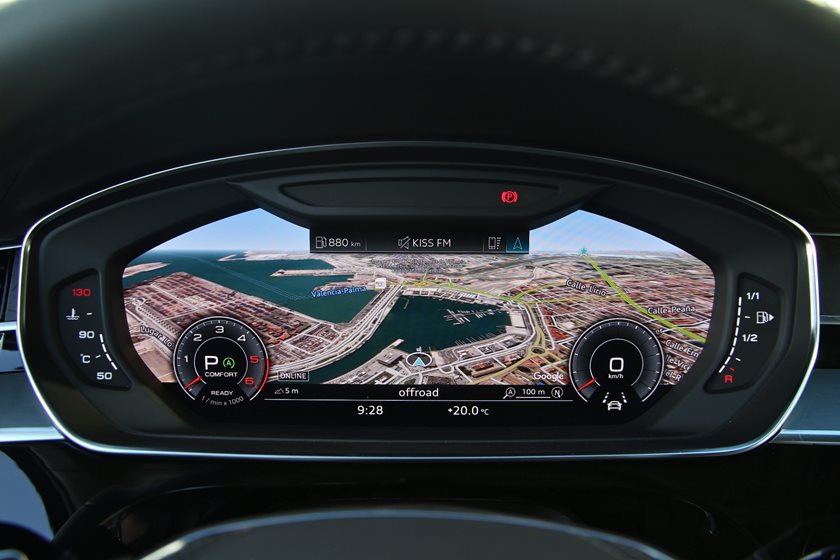
 Coupled with the dynamic all wheel steering this car's high-speed stability
is unerring, which makes for stress free motorway driving. The measured
reduction in turning circle thanks to the rear wheel steering is 1.1 meters,
allowing an A8L to match the 11.4 meters turning circle of the much smaller A4.
At speeds over 37 mph, the rear wheels can turn up to 1.5 degrees to effectively
‘lengthen’ the cars wheelbase, resulting in greater dynamic stability. With
Sport mode engaged, and using the paddle shifters to control the standard
eight-speed Tiptronic used on all variants, the A8 gobbled up the cross country
route, the low roll, exquisite body control and 4WD traction making for rapid,
drama-free progress even at a fair clip.
Coupled with the dynamic all wheel steering this car's high-speed stability
is unerring, which makes for stress free motorway driving. The measured
reduction in turning circle thanks to the rear wheel steering is 1.1 meters,
allowing an A8L to match the 11.4 meters turning circle of the much smaller A4.
At speeds over 37 mph, the rear wheels can turn up to 1.5 degrees to effectively
‘lengthen’ the cars wheelbase, resulting in greater dynamic stability. With
Sport mode engaged, and using the paddle shifters to control the standard
eight-speed Tiptronic used on all variants, the A8 gobbled up the cross country
route, the low roll, exquisite body control and 4WD traction making for rapid,
drama-free progress even at a fair clip.
 The alloy wheel range encompasses 17-inch to 21-inch, and the LWB test cars
at the launch wore 265/40R20-inch Goodyear Eagle F1 rubber, with the entry-level
SWB 50 TDI cars on 255/45R19-inch Michelins. In practice, the suspension is so
well calibrated for all these factory wheel and tire options that the 19s on the
SWB car were barely more comfortable from behind the wheel. Of course while the
smaller 17- and 18-inch sizes might make a bigger difference, they certainly
would not look good on such a large car.
The alloy wheel range encompasses 17-inch to 21-inch, and the LWB test cars
at the launch wore 265/40R20-inch Goodyear Eagle F1 rubber, with the entry-level
SWB 50 TDI cars on 255/45R19-inch Michelins. In practice, the suspension is so
well calibrated for all these factory wheel and tire options that the 19s on the
SWB car were barely more comfortable from behind the wheel. Of course while the
smaller 17- and 18-inch sizes might make a bigger difference, they certainly
would not look good on such a large car.
 For owners in markets such as the US where unleaded gas is the tipple of
choice, the turbocharged V6 55 TFSI quattro with 340 hp and 369 lb-ft of torque,
or the V8 60 TFSI quattro with cylinder-on-demand (COD) technology and 460 hp
and 487 lb-ft, are an extremely comfortable way to cover the miles. I drove the
latter whose engine is refined, potent, and provides good low-end grunt and
strong top-end thrust. Combined with the new chassis, this makes the new A8/L an
incrementally superior car to its forbearers in all respects, including comfort,
performance, fuel economy and emissions.
For owners in markets such as the US where unleaded gas is the tipple of
choice, the turbocharged V6 55 TFSI quattro with 340 hp and 369 lb-ft of torque,
or the V8 60 TFSI quattro with cylinder-on-demand (COD) technology and 460 hp
and 487 lb-ft, are an extremely comfortable way to cover the miles. I drove the
latter whose engine is refined, potent, and provides good low-end grunt and
strong top-end thrust. Combined with the new chassis, this makes the new A8/L an
incrementally superior car to its forbearers in all respects, including comfort,
performance, fuel economy and emissions.
 The W12 flagship, with its supercar challenging 585 hp and 590 lb-ft of
torque, is the only version that does not wear a number badge, just ‘W12’. We
were only able to drive it at modest speeds in a closed off test area, but as
expected its motor is eerily refined. The Audi A8/L production line is housed in
a new building in Neckarsulm, and the 50, 55 and 60 A8/L models go on sale in
Europe immediately, with US deliveries of LWB-only gas models starting in the
second half of 2018. Output will be ramped up over the coming months according
to demand, with up to 260 cars a day possible by late 2018.
The W12 flagship, with its supercar challenging 585 hp and 590 lb-ft of
torque, is the only version that does not wear a number badge, just ‘W12’. We
were only able to drive it at modest speeds in a closed off test area, but as
expected its motor is eerily refined. The Audi A8/L production line is housed in
a new building in Neckarsulm, and the 50, 55 and 60 A8/L models go on sale in
Europe immediately, with US deliveries of LWB-only gas models starting in the
second half of 2018. Output will be ramped up over the coming months according
to demand, with up to 260 cars a day possible by late 2018.The W12 and V8 TDI models will follow during 2018, along with the A8L 60 e-tron quattro, which will be able to drive about 30 miles on battery power and be charged inductively from a garage or carport floor mounted unit. With quattro 4WD and air suspension as standard, the new Audi A8/L stands as the most complete car in its class out of the box. And with a rear seat experience that now matches the much-vaunted and recently face-lifted Mercedes S-Class for secondary ride, Audi finally has a convincing all-round contender in the luxury sedan class.
