The new A7 is as desirable as ever.
Auto manufacturers marketing teams spend a lot of time thinking of catchy names for new niche market models. In the process they sometimes end up with an appellation applicable to a whole slew of vehicles with a similar design theme. In the case of Audi, the Sportback moniker does what it says on the tin, applying a lower and sleeker ‘Coupe’ roofline to their A3, A5 and A7 ranges. Best articulated when given the maximum possible length to develop, this roofline is most effectively seen on the A5 and A7 models, and the 2019 Audi A7 Sportback is no different.
![]() In fact, its greater body width gives the A7 the best overall proportions of
the three. While BMW and Mercedes have always had coupes in their respective
model ranges, none resembled the 6-Series GT or the CLS ‘four-door Coupe’ style.
Audi on the other hand, was able to draw styling inspiration for the first
generation A7 Sportback from its pretty 100 Coupe S, whose long sloping roof and
aerodynamically efficient Kamm tail were more Italian than German at the time. A
modest 30,687 of these stylish front-wheel-drive Coupes were sold between 1970
and 1976, and the survivors are revered and desirable classics today.
In fact, its greater body width gives the A7 the best overall proportions of
the three. While BMW and Mercedes have always had coupes in their respective
model ranges, none resembled the 6-Series GT or the CLS ‘four-door Coupe’ style.
Audi on the other hand, was able to draw styling inspiration for the first
generation A7 Sportback from its pretty 100 Coupe S, whose long sloping roof and
aerodynamically efficient Kamm tail were more Italian than German at the time. A
modest 30,687 of these stylish front-wheel-drive Coupes were sold between 1970
and 1976, and the survivors are revered and desirable classics today.
![]() The first generation A7 Sportback arrived in 2010 amidst much fanfare. The
production version of the Audi Sportback concept that debuted at the 2009
Detroit Show was 95% true to the show car, a fact immediately appreciated by its
buyers. Its sleek roofline falling over tautly drawn bodywork with extended
wheel arches gave the A7 Sportback a wide and purposeful stance on the road. The
car looked especially good when big wheels filled out those wide arches as they
did on the bi-turbo V8-powered RS7. Fast-forward to 2019 and it would not be
wrong to say that the latest A7 is an evolutionary design, but
while its proportions remain very similar the details are where it benefits from
all the current Audi styling idioms.
The first generation A7 Sportback arrived in 2010 amidst much fanfare. The
production version of the Audi Sportback concept that debuted at the 2009
Detroit Show was 95% true to the show car, a fact immediately appreciated by its
buyers. Its sleek roofline falling over tautly drawn bodywork with extended
wheel arches gave the A7 Sportback a wide and purposeful stance on the road. The
car looked especially good when big wheels filled out those wide arches as they
did on the bi-turbo V8-powered RS7. Fast-forward to 2019 and it would not be
wrong to say that the latest A7 is an evolutionary design, but
while its proportions remain very similar the details are where it benefits from
all the current Audi styling idioms.
![]() With less prominent round arches, the new model has more rear shoulder in
keeping with the latest Audi design language. Up front, the distinctive LED
headlamps that flank the large blacked out grille come in three versions – LED
technology, HD Matrix LED, and HD Matrix LED with Audi laser light. This laser
light variant has a distinctive blue emitter that can be clearly seen in the
cluster. At the rear, a full width LED tail light strip emphasizes the new cars
width. The 0.27 drag coefficient is good for the class, but cars shaped like
this tend to suffer from lift over the rear axle at high speed. The engineers
counter lift with an electrically powered rear spoiler that rises at around 75
mph to provide 50 kg of downforce at the car's 155-mph top speed.
With less prominent round arches, the new model has more rear shoulder in
keeping with the latest Audi design language. Up front, the distinctive LED
headlamps that flank the large blacked out grille come in three versions – LED
technology, HD Matrix LED, and HD Matrix LED with Audi laser light. This laser
light variant has a distinctive blue emitter that can be clearly seen in the
cluster. At the rear, a full width LED tail light strip emphasizes the new cars
width. The 0.27 drag coefficient is good for the class, but cars shaped like
this tend to suffer from lift over the rear axle at high speed. The engineers
counter lift with an electrically powered rear spoiler that rises at around 75
mph to provide 50 kg of downforce at the car's 155-mph top speed.
![]()
![]() The cabin is where really massive changes have been wrought and the new
interior bears scant resemblance to what went before. As on the current A8, new processors in the
infotainment system are 50 times faster than before and have two large
touchscreen displays - a 1540 x 720 pixel, 10.1 inch on the dashboard, and a
1280 x 660, 8.6-inch screen below it on the center console. The bigger screen
looks after infotainment, while the smaller one controls the HVAC system and
some convenience features. It also has text input by handwriting or virtual
keyboard.
The cabin is where really massive changes have been wrought and the new
interior bears scant resemblance to what went before. As on the current A8, new processors in the
infotainment system are 50 times faster than before and have two large
touchscreen displays - a 1540 x 720 pixel, 10.1 inch on the dashboard, and a
1280 x 660, 8.6-inch screen below it on the center console. The bigger screen
looks after infotainment, while the smaller one controls the HVAC system and
some convenience features. It also has text input by handwriting or virtual
keyboard.
![]()
![]() The 12.3-inch Virtual Cockpit instrument pack in front of the driver will be
familiar to anyone who has driven one of the current Audi A4, TT or R8 models. A
head-up display is an option. The front seats are extremely comfortable. Our
high spec test car seats had electric adjustments in all directions plus lumber
support. Seat heating and cooling are other functions expected of a car in this
class and were present and accounted for. The three optional trim levels are
standard, design selection and S line sport package, with a choice of Nappa
leather and Alcantara, or Valcona leather.
The 12.3-inch Virtual Cockpit instrument pack in front of the driver will be
familiar to anyone who has driven one of the current Audi A4, TT or R8 models. A
head-up display is an option. The front seats are extremely comfortable. Our
high spec test car seats had electric adjustments in all directions plus lumber
support. Seat heating and cooling are other functions expected of a car in this
class and were present and accounted for. The three optional trim levels are
standard, design selection and S line sport package, with a choice of Nappa
leather and Alcantara, or Valcona leather.
![]()
![]() The contrast between the black piano lacquer on the 55 TSFI and open pored
wood on my 50 TDI test cars showed off the breadth of choice for the wood
inlays. Rear seat legroom is good, and seems comparable to the current A6 sedan
or a short wheelbase A8. The sloping roofline hardly impinges on rear headroom,
and my 6ft 1 in tall colleague had no problems. One of the advantages the A7 has
leveraged over the CLS from day one is the versatility of its hatchback design,
which pushed Mercedes to expensively create the Shooting Brake variant after the
fact for their second generation CLS.
The contrast between the black piano lacquer on the 55 TSFI and open pored
wood on my 50 TDI test cars showed off the breadth of choice for the wood
inlays. Rear seat legroom is good, and seems comparable to the current A6 sedan
or a short wheelbase A8. The sloping roofline hardly impinges on rear headroom,
and my 6ft 1 in tall colleague had no problems. One of the advantages the A7 has
leveraged over the CLS from day one is the versatility of its hatchback design,
which pushed Mercedes to expensively create the Shooting Brake variant after the
fact for their second generation CLS.
![]()
![]() As you would expect of a large hatchback, the generous 535 liters trunk turns
into a capacious 1,390 liters of load space when the 40/60 split rear seats are
folded down. Importantly for golfers, the wider opening is now 1,050 mm so two
golf bags can be placed across the rear of the trunk. The most basic A7
Sportback comes with 18-inch alloys, with sizes extending to 19, 20 and 21-inch,
the last size standard on flagship models with air suspension. Our 55 TFSI test
car wore these 8.5J x 21-inch alloys shod with 255/35ZR21 Pirellis, while the 50
TDI came with 8.5J x 20-inch wheels and 255/40ZR20 Michelins.
As you would expect of a large hatchback, the generous 535 liters trunk turns
into a capacious 1,390 liters of load space when the 40/60 split rear seats are
folded down. Importantly for golfers, the wider opening is now 1,050 mm so two
golf bags can be placed across the rear of the trunk. The most basic A7
Sportback comes with 18-inch alloys, with sizes extending to 19, 20 and 21-inch,
the last size standard on flagship models with air suspension. Our 55 TFSI test
car wore these 8.5J x 21-inch alloys shod with 255/35ZR21 Pirellis, while the 50
TDI came with 8.5J x 20-inch wheels and 255/40ZR20 Michelins.
![]()
![]() All tire sizes from 19-inch upwards come equipped with a layer of special
foam glued to the inside of the tire on the opposite side of the tread said to
dampen road noise by up to 9dB. This is not an industry first as it was already
adopted by Mercedes for the Maybach and McLaren on the 570GT, but the additional
refinement it brings is invaluable. That said, a totally unique A7 Sportback
feature is a function integrated into the ESC that warns the driver if a wheel
is not on tight. While the NVH in the A7’s cabin is very low and the car is
whisper quiet mechanically at 8 0mph on the highway, I could distinctly hear
more road noise from the driver’s seat than from the rear cabin.
All tire sizes from 19-inch upwards come equipped with a layer of special
foam glued to the inside of the tire on the opposite side of the tread said to
dampen road noise by up to 9dB. This is not an industry first as it was already
adopted by Mercedes for the Maybach and McLaren on the 570GT, but the additional
refinement it brings is invaluable. That said, a totally unique A7 Sportback
feature is a function integrated into the ESC that warns the driver if a wheel
is not on tight. While the NVH in the A7’s cabin is very low and the car is
whisper quiet mechanically at 8 0mph on the highway, I could distinctly hear
more road noise from the driver’s seat than from the rear cabin.
![]() I don’t remember the same being so in the current A6, and certainly not in
the A8. Like its predecessor the new A7 Sportback is wider than the A6 and feels
practically as wide as the A8. So while the rear steering option gives the A7
very good turn in and cornering agility for a car of its size and weight, the
narrow, winding coast road that made up part of our test route also highlighted
its sheer physical size as well. The fast, open roads up in the mountains near
Stellenbosch were another story, and here the A7 Sportback was in its element.
With the car in Dynamic mode the crisp turn-in, low body roll, the unerring
quattro four-wheel drive grip, and good engine power made for swift and
comfortable progress.
I don’t remember the same being so in the current A6, and certainly not in
the A8. Like its predecessor the new A7 Sportback is wider than the A6 and feels
practically as wide as the A8. So while the rear steering option gives the A7
very good turn in and cornering agility for a car of its size and weight, the
narrow, winding coast road that made up part of our test route also highlighted
its sheer physical size as well. The fast, open roads up in the mountains near
Stellenbosch were another story, and here the A7 Sportback was in its element.
With the car in Dynamic mode the crisp turn-in, low body roll, the unerring
quattro four-wheel drive grip, and good engine power made for swift and
comfortable progress.
![]() The electric power steering is quick and responsive, and helped by the rear
steering you can feel the A7 move away from the straight-ahead as soon as you
turn the wheel. But this agility in no way courts nervousness, and the car
exhibited rock solid stability when I pushed it hard through the wide sweeping
corners up in the mountains. In Comfort mode around town the air suspension
delivers a cossetting secondary ride. But when you start to go more quickly, say
up to 60 mph on undulating roads, there is a bit of looseness in the body
control. Thus I ended up using Auto mode as my default setting, which strikes a
good balance between Comfort and Dynamic modes, leaning either way according to
the prevailing road conditions.
The electric power steering is quick and responsive, and helped by the rear
steering you can feel the A7 move away from the straight-ahead as soon as you
turn the wheel. But this agility in no way courts nervousness, and the car
exhibited rock solid stability when I pushed it hard through the wide sweeping
corners up in the mountains. In Comfort mode around town the air suspension
delivers a cossetting secondary ride. But when you start to go more quickly, say
up to 60 mph on undulating roads, there is a bit of looseness in the body
control. Thus I ended up using Auto mode as my default setting, which strikes a
good balance between Comfort and Dynamic modes, leaning either way according to
the prevailing road conditions.
![]() Chassis engineer, Carsten Jablonowski, explained that the air suspension
system on the A7 Sportback is a different configuration to that of the A8
because of packaging considerations. “We use a concentric air spring and active
damper system on the A8 for the best possible ride quality. As all the forces
bear in one plane this minimizes friction to the benefit of ride quality,” he
explained. “However, this design takes up more physical space in the vertical
plane and is thus unsuitable for a station wagon or hatchback like the A7 where
load space is a key feature,” he said.
Chassis engineer, Carsten Jablonowski, explained that the air suspension
system on the A7 Sportback is a different configuration to that of the A8
because of packaging considerations. “We use a concentric air spring and active
damper system on the A8 for the best possible ride quality. As all the forces
bear in one plane this minimizes friction to the benefit of ride quality,” he
explained. “However, this design takes up more physical space in the vertical
plane and is thus unsuitable for a station wagon or hatchback like the A7 where
load space is a key feature,” he said.
![]() “Here we separate the air spring and active damper, and accept the compromise
of the extra friction and forces on the rear sub-frame as the suspension moves
through its operating range.” That said, the air suspended A7 Sportback rides
extremely well and should elicit no complaints from its owners. On the fly, the
turbo-diesel turned out to be my preferred mount in everyday driving. Bestowed
with 286 hp from 3,500 to 4,000 rpm with 479 lb-ft of twist from 2,250 to 3,000
rpm, it has more effortless go than the TFSI motor, whose 340 hp peaks from
5,000 to 6,400 rpm with 369 lb-ft of torque from 1,370 to 4,500 rpm.
“Here we separate the air spring and active damper, and accept the compromise
of the extra friction and forces on the rear sub-frame as the suspension moves
through its operating range.” That said, the air suspended A7 Sportback rides
extremely well and should elicit no complaints from its owners. On the fly, the
turbo-diesel turned out to be my preferred mount in everyday driving. Bestowed
with 286 hp from 3,500 to 4,000 rpm with 479 lb-ft of twist from 2,250 to 3,000
rpm, it has more effortless go than the TFSI motor, whose 340 hp peaks from
5,000 to 6,400 rpm with 369 lb-ft of torque from 1,370 to 4,500 rpm.
![]() Against the stopwatch the V6 TFSI is quicker to 62 mph, showing 5.3 sec
against 5.7 sec, but it also has to be revved relatively harder to make the same
progress, and so is a less relaxed car over distance. Of course all this is
relative, and both are quick and effortless in daily driving conditions,
although there is no doubt that the diesel will also make fewer fuel stops. On
that score, with Audi Drive Select set to Economy the A7 has a ‘sailing’ mode
where the transmission will disengage the motor, dropping it back to idle speed
to save fuel.
Against the stopwatch the V6 TFSI is quicker to 62 mph, showing 5.3 sec
against 5.7 sec, but it also has to be revved relatively harder to make the same
progress, and so is a less relaxed car over distance. Of course all this is
relative, and both are quick and effortless in daily driving conditions,
although there is no doubt that the diesel will also make fewer fuel stops. On
that score, with Audi Drive Select set to Economy the A7 has a ‘sailing’ mode
where the transmission will disengage the motor, dropping it back to idle speed
to save fuel.
![]() Disappointingly, for the time being at least, the Audi Sport Differential,
which sends more power to the rear in Sport mode, can only be combined with the
ZF eight-speed Tiptronic automatic transmission that partners the torque rich 50
TDI engine. The reason is the torque limitation of the Audi-made S-Tronic
twin-clutch gearbox used on the gasoline 55 TFSI. The new A7 Sportback will
appear in European showrooms in March, with an on-sale date in the US and China
set for the fourth quarter of this year. When asked about the expected high
performance S7 and RS7 models, the Audi engineers just gave us a knowing
grin.
Disappointingly, for the time being at least, the Audi Sport Differential,
which sends more power to the rear in Sport mode, can only be combined with the
ZF eight-speed Tiptronic automatic transmission that partners the torque rich 50
TDI engine. The reason is the torque limitation of the Audi-made S-Tronic
twin-clutch gearbox used on the gasoline 55 TFSI. The new A7 Sportback will
appear in European showrooms in March, with an on-sale date in the US and China
set for the fourth quarter of this year. When asked about the expected high
performance S7 and RS7 models, the Audi engineers just gave us a knowing
grin.
![]()
![]()
![]()
Auto manufacturers marketing teams spend a lot of time thinking of catchy names for new niche market models. In the process they sometimes end up with an appellation applicable to a whole slew of vehicles with a similar design theme. In the case of Audi, the Sportback moniker does what it says on the tin, applying a lower and sleeker ‘Coupe’ roofline to their A3, A5 and A7 ranges. Best articulated when given the maximum possible length to develop, this roofline is most effectively seen on the A5 and A7 models, and the 2019 Audi A7 Sportback is no different.
 In fact, its greater body width gives the A7 the best overall proportions of
the three. While BMW and Mercedes have always had coupes in their respective
model ranges, none resembled the 6-Series GT or the CLS ‘four-door Coupe’ style.
Audi on the other hand, was able to draw styling inspiration for the first
generation A7 Sportback from its pretty 100 Coupe S, whose long sloping roof and
aerodynamically efficient Kamm tail were more Italian than German at the time. A
modest 30,687 of these stylish front-wheel-drive Coupes were sold between 1970
and 1976, and the survivors are revered and desirable classics today.
In fact, its greater body width gives the A7 the best overall proportions of
the three. While BMW and Mercedes have always had coupes in their respective
model ranges, none resembled the 6-Series GT or the CLS ‘four-door Coupe’ style.
Audi on the other hand, was able to draw styling inspiration for the first
generation A7 Sportback from its pretty 100 Coupe S, whose long sloping roof and
aerodynamically efficient Kamm tail were more Italian than German at the time. A
modest 30,687 of these stylish front-wheel-drive Coupes were sold between 1970
and 1976, and the survivors are revered and desirable classics today.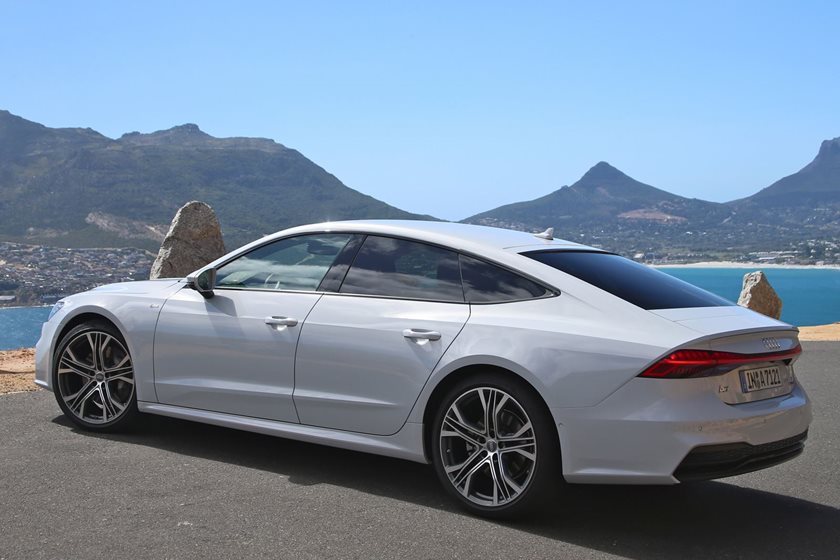 The first generation A7 Sportback arrived in 2010 amidst much fanfare. The
production version of the Audi Sportback concept that debuted at the 2009
Detroit Show was 95% true to the show car, a fact immediately appreciated by its
buyers. Its sleek roofline falling over tautly drawn bodywork with extended
wheel arches gave the A7 Sportback a wide and purposeful stance on the road. The
car looked especially good when big wheels filled out those wide arches as they
did on the bi-turbo V8-powered RS7. Fast-forward to 2019 and it would not be
wrong to say that the latest A7 is an evolutionary design, but
while its proportions remain very similar the details are where it benefits from
all the current Audi styling idioms.
The first generation A7 Sportback arrived in 2010 amidst much fanfare. The
production version of the Audi Sportback concept that debuted at the 2009
Detroit Show was 95% true to the show car, a fact immediately appreciated by its
buyers. Its sleek roofline falling over tautly drawn bodywork with extended
wheel arches gave the A7 Sportback a wide and purposeful stance on the road. The
car looked especially good when big wheels filled out those wide arches as they
did on the bi-turbo V8-powered RS7. Fast-forward to 2019 and it would not be
wrong to say that the latest A7 is an evolutionary design, but
while its proportions remain very similar the details are where it benefits from
all the current Audi styling idioms. With less prominent round arches, the new model has more rear shoulder in
keeping with the latest Audi design language. Up front, the distinctive LED
headlamps that flank the large blacked out grille come in three versions – LED
technology, HD Matrix LED, and HD Matrix LED with Audi laser light. This laser
light variant has a distinctive blue emitter that can be clearly seen in the
cluster. At the rear, a full width LED tail light strip emphasizes the new cars
width. The 0.27 drag coefficient is good for the class, but cars shaped like
this tend to suffer from lift over the rear axle at high speed. The engineers
counter lift with an electrically powered rear spoiler that rises at around 75
mph to provide 50 kg of downforce at the car's 155-mph top speed.
With less prominent round arches, the new model has more rear shoulder in
keeping with the latest Audi design language. Up front, the distinctive LED
headlamps that flank the large blacked out grille come in three versions – LED
technology, HD Matrix LED, and HD Matrix LED with Audi laser light. This laser
light variant has a distinctive blue emitter that can be clearly seen in the
cluster. At the rear, a full width LED tail light strip emphasizes the new cars
width. The 0.27 drag coefficient is good for the class, but cars shaped like
this tend to suffer from lift over the rear axle at high speed. The engineers
counter lift with an electrically powered rear spoiler that rises at around 75
mph to provide 50 kg of downforce at the car's 155-mph top speed.
 The cabin is where really massive changes have been wrought and the new
interior bears scant resemblance to what went before. As on the current A8, new processors in the
infotainment system are 50 times faster than before and have two large
touchscreen displays - a 1540 x 720 pixel, 10.1 inch on the dashboard, and a
1280 x 660, 8.6-inch screen below it on the center console. The bigger screen
looks after infotainment, while the smaller one controls the HVAC system and
some convenience features. It also has text input by handwriting or virtual
keyboard.
The cabin is where really massive changes have been wrought and the new
interior bears scant resemblance to what went before. As on the current A8, new processors in the
infotainment system are 50 times faster than before and have two large
touchscreen displays - a 1540 x 720 pixel, 10.1 inch on the dashboard, and a
1280 x 660, 8.6-inch screen below it on the center console. The bigger screen
looks after infotainment, while the smaller one controls the HVAC system and
some convenience features. It also has text input by handwriting or virtual
keyboard.
 The 12.3-inch Virtual Cockpit instrument pack in front of the driver will be
familiar to anyone who has driven one of the current Audi A4, TT or R8 models. A
head-up display is an option. The front seats are extremely comfortable. Our
high spec test car seats had electric adjustments in all directions plus lumber
support. Seat heating and cooling are other functions expected of a car in this
class and were present and accounted for. The three optional trim levels are
standard, design selection and S line sport package, with a choice of Nappa
leather and Alcantara, or Valcona leather.
The 12.3-inch Virtual Cockpit instrument pack in front of the driver will be
familiar to anyone who has driven one of the current Audi A4, TT or R8 models. A
head-up display is an option. The front seats are extremely comfortable. Our
high spec test car seats had electric adjustments in all directions plus lumber
support. Seat heating and cooling are other functions expected of a car in this
class and were present and accounted for. The three optional trim levels are
standard, design selection and S line sport package, with a choice of Nappa
leather and Alcantara, or Valcona leather.
 The contrast between the black piano lacquer on the 55 TSFI and open pored
wood on my 50 TDI test cars showed off the breadth of choice for the wood
inlays. Rear seat legroom is good, and seems comparable to the current A6 sedan
or a short wheelbase A8. The sloping roofline hardly impinges on rear headroom,
and my 6ft 1 in tall colleague had no problems. One of the advantages the A7 has
leveraged over the CLS from day one is the versatility of its hatchback design,
which pushed Mercedes to expensively create the Shooting Brake variant after the
fact for their second generation CLS.
The contrast between the black piano lacquer on the 55 TSFI and open pored
wood on my 50 TDI test cars showed off the breadth of choice for the wood
inlays. Rear seat legroom is good, and seems comparable to the current A6 sedan
or a short wheelbase A8. The sloping roofline hardly impinges on rear headroom,
and my 6ft 1 in tall colleague had no problems. One of the advantages the A7 has
leveraged over the CLS from day one is the versatility of its hatchback design,
which pushed Mercedes to expensively create the Shooting Brake variant after the
fact for their second generation CLS.
 As you would expect of a large hatchback, the generous 535 liters trunk turns
into a capacious 1,390 liters of load space when the 40/60 split rear seats are
folded down. Importantly for golfers, the wider opening is now 1,050 mm so two
golf bags can be placed across the rear of the trunk. The most basic A7
Sportback comes with 18-inch alloys, with sizes extending to 19, 20 and 21-inch,
the last size standard on flagship models with air suspension. Our 55 TFSI test
car wore these 8.5J x 21-inch alloys shod with 255/35ZR21 Pirellis, while the 50
TDI came with 8.5J x 20-inch wheels and 255/40ZR20 Michelins.
As you would expect of a large hatchback, the generous 535 liters trunk turns
into a capacious 1,390 liters of load space when the 40/60 split rear seats are
folded down. Importantly for golfers, the wider opening is now 1,050 mm so two
golf bags can be placed across the rear of the trunk. The most basic A7
Sportback comes with 18-inch alloys, with sizes extending to 19, 20 and 21-inch,
the last size standard on flagship models with air suspension. Our 55 TFSI test
car wore these 8.5J x 21-inch alloys shod with 255/35ZR21 Pirellis, while the 50
TDI came with 8.5J x 20-inch wheels and 255/40ZR20 Michelins.
 All tire sizes from 19-inch upwards come equipped with a layer of special
foam glued to the inside of the tire on the opposite side of the tread said to
dampen road noise by up to 9dB. This is not an industry first as it was already
adopted by Mercedes for the Maybach and McLaren on the 570GT, but the additional
refinement it brings is invaluable. That said, a totally unique A7 Sportback
feature is a function integrated into the ESC that warns the driver if a wheel
is not on tight. While the NVH in the A7’s cabin is very low and the car is
whisper quiet mechanically at 8 0mph on the highway, I could distinctly hear
more road noise from the driver’s seat than from the rear cabin.
All tire sizes from 19-inch upwards come equipped with a layer of special
foam glued to the inside of the tire on the opposite side of the tread said to
dampen road noise by up to 9dB. This is not an industry first as it was already
adopted by Mercedes for the Maybach and McLaren on the 570GT, but the additional
refinement it brings is invaluable. That said, a totally unique A7 Sportback
feature is a function integrated into the ESC that warns the driver if a wheel
is not on tight. While the NVH in the A7’s cabin is very low and the car is
whisper quiet mechanically at 8 0mph on the highway, I could distinctly hear
more road noise from the driver’s seat than from the rear cabin. I don’t remember the same being so in the current A6, and certainly not in
the A8. Like its predecessor the new A7 Sportback is wider than the A6 and feels
practically as wide as the A8. So while the rear steering option gives the A7
very good turn in and cornering agility for a car of its size and weight, the
narrow, winding coast road that made up part of our test route also highlighted
its sheer physical size as well. The fast, open roads up in the mountains near
Stellenbosch were another story, and here the A7 Sportback was in its element.
With the car in Dynamic mode the crisp turn-in, low body roll, the unerring
quattro four-wheel drive grip, and good engine power made for swift and
comfortable progress.
I don’t remember the same being so in the current A6, and certainly not in
the A8. Like its predecessor the new A7 Sportback is wider than the A6 and feels
practically as wide as the A8. So while the rear steering option gives the A7
very good turn in and cornering agility for a car of its size and weight, the
narrow, winding coast road that made up part of our test route also highlighted
its sheer physical size as well. The fast, open roads up in the mountains near
Stellenbosch were another story, and here the A7 Sportback was in its element.
With the car in Dynamic mode the crisp turn-in, low body roll, the unerring
quattro four-wheel drive grip, and good engine power made for swift and
comfortable progress. The electric power steering is quick and responsive, and helped by the rear
steering you can feel the A7 move away from the straight-ahead as soon as you
turn the wheel. But this agility in no way courts nervousness, and the car
exhibited rock solid stability when I pushed it hard through the wide sweeping
corners up in the mountains. In Comfort mode around town the air suspension
delivers a cossetting secondary ride. But when you start to go more quickly, say
up to 60 mph on undulating roads, there is a bit of looseness in the body
control. Thus I ended up using Auto mode as my default setting, which strikes a
good balance between Comfort and Dynamic modes, leaning either way according to
the prevailing road conditions.
The electric power steering is quick and responsive, and helped by the rear
steering you can feel the A7 move away from the straight-ahead as soon as you
turn the wheel. But this agility in no way courts nervousness, and the car
exhibited rock solid stability when I pushed it hard through the wide sweeping
corners up in the mountains. In Comfort mode around town the air suspension
delivers a cossetting secondary ride. But when you start to go more quickly, say
up to 60 mph on undulating roads, there is a bit of looseness in the body
control. Thus I ended up using Auto mode as my default setting, which strikes a
good balance between Comfort and Dynamic modes, leaning either way according to
the prevailing road conditions. Chassis engineer, Carsten Jablonowski, explained that the air suspension
system on the A7 Sportback is a different configuration to that of the A8
because of packaging considerations. “We use a concentric air spring and active
damper system on the A8 for the best possible ride quality. As all the forces
bear in one plane this minimizes friction to the benefit of ride quality,” he
explained. “However, this design takes up more physical space in the vertical
plane and is thus unsuitable for a station wagon or hatchback like the A7 where
load space is a key feature,” he said.
Chassis engineer, Carsten Jablonowski, explained that the air suspension
system on the A7 Sportback is a different configuration to that of the A8
because of packaging considerations. “We use a concentric air spring and active
damper system on the A8 for the best possible ride quality. As all the forces
bear in one plane this minimizes friction to the benefit of ride quality,” he
explained. “However, this design takes up more physical space in the vertical
plane and is thus unsuitable for a station wagon or hatchback like the A7 where
load space is a key feature,” he said. “Here we separate the air spring and active damper, and accept the compromise
of the extra friction and forces on the rear sub-frame as the suspension moves
through its operating range.” That said, the air suspended A7 Sportback rides
extremely well and should elicit no complaints from its owners. On the fly, the
turbo-diesel turned out to be my preferred mount in everyday driving. Bestowed
with 286 hp from 3,500 to 4,000 rpm with 479 lb-ft of twist from 2,250 to 3,000
rpm, it has more effortless go than the TFSI motor, whose 340 hp peaks from
5,000 to 6,400 rpm with 369 lb-ft of torque from 1,370 to 4,500 rpm.
“Here we separate the air spring and active damper, and accept the compromise
of the extra friction and forces on the rear sub-frame as the suspension moves
through its operating range.” That said, the air suspended A7 Sportback rides
extremely well and should elicit no complaints from its owners. On the fly, the
turbo-diesel turned out to be my preferred mount in everyday driving. Bestowed
with 286 hp from 3,500 to 4,000 rpm with 479 lb-ft of twist from 2,250 to 3,000
rpm, it has more effortless go than the TFSI motor, whose 340 hp peaks from
5,000 to 6,400 rpm with 369 lb-ft of torque from 1,370 to 4,500 rpm. Against the stopwatch the V6 TFSI is quicker to 62 mph, showing 5.3 sec
against 5.7 sec, but it also has to be revved relatively harder to make the same
progress, and so is a less relaxed car over distance. Of course all this is
relative, and both are quick and effortless in daily driving conditions,
although there is no doubt that the diesel will also make fewer fuel stops. On
that score, with Audi Drive Select set to Economy the A7 has a ‘sailing’ mode
where the transmission will disengage the motor, dropping it back to idle speed
to save fuel.
Against the stopwatch the V6 TFSI is quicker to 62 mph, showing 5.3 sec
against 5.7 sec, but it also has to be revved relatively harder to make the same
progress, and so is a less relaxed car over distance. Of course all this is
relative, and both are quick and effortless in daily driving conditions,
although there is no doubt that the diesel will also make fewer fuel stops. On
that score, with Audi Drive Select set to Economy the A7 has a ‘sailing’ mode
where the transmission will disengage the motor, dropping it back to idle speed
to save fuel. Disappointingly, for the time being at least, the Audi Sport Differential,
which sends more power to the rear in Sport mode, can only be combined with the
ZF eight-speed Tiptronic automatic transmission that partners the torque rich 50
TDI engine. The reason is the torque limitation of the Audi-made S-Tronic
twin-clutch gearbox used on the gasoline 55 TFSI. The new A7 Sportback will
appear in European showrooms in March, with an on-sale date in the US and China
set for the fourth quarter of this year. When asked about the expected high
performance S7 and RS7 models, the Audi engineers just gave us a knowing
grin.
Disappointingly, for the time being at least, the Audi Sport Differential,
which sends more power to the rear in Sport mode, can only be combined with the
ZF eight-speed Tiptronic automatic transmission that partners the torque rich 50
TDI engine. The reason is the torque limitation of the Audi-made S-Tronic
twin-clutch gearbox used on the gasoline 55 TFSI. The new A7 Sportback will
appear in European showrooms in March, with an on-sale date in the US and China
set for the fourth quarter of this year. When asked about the expected high
performance S7 and RS7 models, the Audi engineers just gave us a knowing
grin.


